You live in a world that is faster, louder, and more distracted than any generation before you has faced. Notifications compete for your attention. Productivity has been turned into a moral virtue. Success is measured in metrics, follower counts, and net worth. And yet, despite all this material abundance and digital connection, a quiet but growing number of people report feeling profoundly empty inside.
Anxiety, burnout, and a loss of meaning are now among the most widely discussed challenges of modern life. Mental health professionals, researchers, and philosophers alike are pointing to the same underlying problem: many people are deeply disconnected, from themselves, from others, and from any sense of larger purpose.
This is exactly where spirituality enters the conversation, not as a relic from a pre-scientific past, but as a living, breathing framework for navigating life with greater depth, resilience, and presence. According to a 2022 Pew Research Center report, nearly 75% of Americans identify as either religious or spiritual, and the number of people who describe themselves as “spiritual but not religious” has grown substantially over the past two decades.
Spirituality is not about escaping the real world. It is about engaging with it more fully. It is the inner dimension of human life that asks the questions no algorithm can answer: Who am I? Why am I here? What truly matters? These are not soft or sentimental questions. They are among the most courageous a person can ask.
This post takes those questions seriously. It walks you through what spirituality actually means, what it looks like in practice, how the world’s great traditions frame it, and how you can recognize genuine spiritual growth in your own life.
Key Takeaways
- Spirituality is a personal, evolving search for deeper meaning, connection, and inner peace, and it does not require religious affiliation to be valid or transformative.
- The core characteristics of spirituality include transcendence, interconnectedness, compassion, purpose-seeking, and a genuine openness to life’s deepest mysteries.
- Spiritual practices like meditation, mindfulness, journaling, yoga, and acts of service actively deepen self-awareness and strengthen your sense of connection to something greater.
- Spirituality exists within every major world religion, yet it also thrives entirely outside organized religion, including within secular and atheistic frameworks.
- Signs of spiritual progress are practical and observable: greater empathy, reduced reactivity, increased gratitude, and a growing sense of inner wholeness.
Definition of Spirituality: What It Really Means
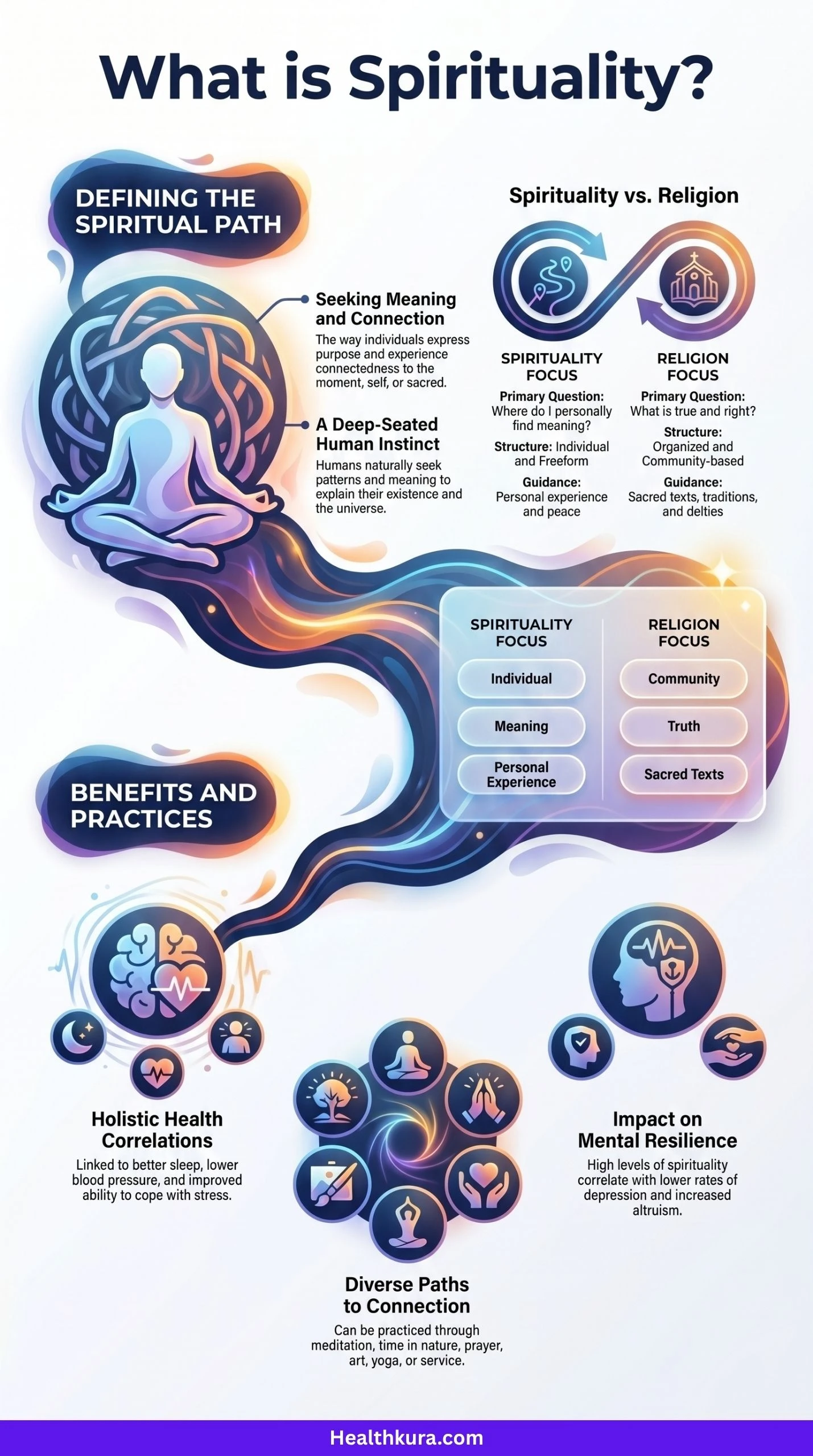
Spirituality is the human pursuit of connection to something greater than the individual self, combined with a search for meaning, purpose, and inner peace. It is personal, dynamic, and largely self-directed. It cannot be reduced to a set of rituals or doctrines, though rituals and doctrines can certainly support it.
At its most fundamental level, spirituality involves three interrelated movements. The first is turning inward, developing a deeper awareness of your own inner life, your values, your motivations, and the silence beneath your thoughts. The second is reaching outward, feeling a genuine sense of connection to other people, to nature, to the universe, or to a higher power, depending on your worldview. The third is moving upward, orienting your life toward something that transcends everyday concerns, whether that is love, truth, divine presence, or the liberation from suffering.
The word “spirituality” derives from the Latin spiritus, meaning breath or life force. That etymology is more than linguistic trivia. It points to something essential: the spirit is what animates life from within. Every culture in human history has recognized some version of this inner dimension, even when the language used to describe it differs dramatically.
Contemporary researchers like Dr. Lisa Miller, author of The Spiritual Child, have documented that people with a developed spiritual life show measurably greater resilience, lower rates of depression, and stronger immune function. The science here is not metaphysical speculation. It is peer-reviewed research published in leading academic journals.
What spirituality is not is equally important to understand. It is not necessarily theistic. It is not equivalent to religion, though it can exist within religion. It is not passivity or withdrawal from life. And it is certainly not spiritual bypassing, using spiritual ideas to avoid emotional responsibility or real-world accountability.
Spirituality is a practice of presence. It is the ongoing work of becoming more fully yourself while simultaneously recognizing your connection to everything beyond yourself.
Characteristics of Spirituality: The Core Traits That Define It
Spirituality, across all its forms, tends to express itself through a consistent set of qualities. These are not a checklist to complete. They are tendencies that deepen naturally as the inner life matures.
1) Transcendence
Transcendence refers to the capacity to experience reality beyond the ordinary boundaries of the ego. It is the sense, sometimes fleeting but unmistakable, that you are more than your name, your job title, your fears, or your past. Many people first encounter transcendence in moments of awe, standing at the edge of the ocean, witnessing a birth, or sitting in silence during a crisis and finding an unexpected stillness.
The philosopher Abraham Maslow described this as a “peak experience,” a moment in which the ordinary sense of separateness dissolves and a deeper unity with life becomes directly felt. Spiritual traditions across the world have cultivated systematic methods for accessing this state reliably, rather than waiting for it to arrive by accident.
2) Interconnectedness
Interconnectedness is the recognition that your life is not an isolated event. You are embedded in a vast web of relationships, with other humans, with ecosystems, with ancestral lineages, and with the forces that sustain the cosmos itself. This is not poetic metaphor. Modern physics, ecology, and systems theory all converge on the same basic insight: nothing exists in isolation.
Spirituality makes this awareness personal and lived. When you genuinely feel your connection to others, your behavior changes. Compassion becomes less of an effort and more of a natural expression. Exploitation becomes harder to justify. Gratitude becomes easier to access.
3) Purpose-Seeking
Every authentic spiritual path takes purpose seriously. This is the drive to live a life that is oriented toward something meaningful rather than simply comfortable. Purpose-seeking does not mean you have all the answers. It means you are willing to ask the questions. It means your choices are increasingly guided by values rather than impulse, and by long-term meaning rather than short-term pleasure.
Viktor Frankl, the psychiatrist and Holocaust survivor, observed in his landmark work Man’s Search for Meaning that human beings can endure almost any suffering if they have a clear enough “why.” Spirituality provides that why, not as a ready-made slogan, but as a living orientation that you discover and refine through direct experience.
4) Inner Harmony
Inner harmony does not mean the absence of conflict, difficulty, or pain. It means developing the capacity to hold complexity without being shattered by it. It is the difference between being tossed around by every emotional wave and developing the ability to stand steady within the storm.
This quality emerges gradually through practice. It is the fruit of sustained self-awareness, of learning to observe your thoughts rather than be controlled by them, and of developing what contemplative traditions call equanimity. Inner harmony is not emotional flatness. It is a kind of spaciousness that allows you to feel deeply without losing yourself.
5) Compassion
Compassion is arguably the most universally celebrated fruit of genuine spirituality. Across every tradition, from Buddhist karuna to Christian agape to the Islamic concept of rahma, the deepening of spiritual life reliably produces an expansion of the heart’s capacity to care for others.
This is not sentimentality. Compassion rooted in spiritual understanding includes both warmth and clarity. It motivates action. It drives justice. And it begins with the willingness to be compassionate toward yourself, to stop treating your own inner life with contempt.
6) Openness to Mystery
Mature spirituality holds uncertainty with grace. It does not demand that every question be answered or every experience be explained. The universe is immense, complex, and, by any honest measure, largely beyond human comprehension. The spiritually developed person does not find this terrifying. They find it humbling, even beautiful.
This openness is not intellectual laziness. It is a form of intellectual honesty. It acknowledges the limits of the rational mind while remaining genuinely curious about what lies beyond those limits.
Forms of Spiritual Practice: How People Actually Do It
Spiritual development is not passive. It requires intentional practice, a regular commitment to activities that cultivate inner awareness, deepen connection, and realign you with your deepest values. The specific practice matters less than the sincerity and consistency with which you engage it.
Meditation
Meditation is one of the oldest and most well-researched spiritual practices in the world. At its core, it involves training the mind to rest in present-moment awareness, whether by focusing on the breath, a mantra, a visual object, or simply the open field of consciousness itself. Neuroscientific research from institutions like Harvard Medical School has documented that consistent meditation practice physically alters the brain, thickening the cortex in areas associated with attention and compassion, and reducing activity in the amygdala, the brain’s fear center.
Meditation is practiced across virtually every spiritual tradition. In Buddhism, it is the central practice of liberation. In Hinduism, dhyana (meditation) is one of the eight limbs of yoga. In Christian contemplative traditions, practices like Centering Prayer and Lectio Divina serve a similar function. The specific technique varies widely, but the intention is the same: to quiet the noise of the surface mind and access the deeper stillness beneath.
Prayer
Prayer is perhaps the most widely practiced spiritual activity on Earth. It is more than asking for things. Genuine prayer is a turning of the whole self toward whatever one understands the divine or ultimate reality to be. It is an act of attention, of relationship, and of surrender.
For many people, prayer functions as a daily anchor. It begins and ends the day with a conscious recognition that life is held within a larger context. Research published in the Journal of Religion and Health consistently links regular prayer practice to lower levels of psychological distress and greater life satisfaction.
Prayer can be spoken or silent, structured or spontaneous, individual or communal. What makes it spiritual is the quality of presence and sincerity brought to it.
Mindfulness
Mindfulness has moved from Buddhist monasteries into corporate boardrooms and hospital waiting rooms, and for good reason. It is the practice of paying deliberate, non-judgmental attention to the present moment, including your thoughts, sensations, emotions, and the environment around you.
Jon Kabat-Zinn, who developed Mindfulness-Based Stress Reduction (MBSR) at the University of Massachusetts Medical School, famously defined mindfulness as “paying attention in a particular way, on purpose, in the present moment, non-judgmentally.” Decades of clinical research have demonstrated its effectiveness in reducing anxiety, improving focus, and increasing emotional resilience.
Mindfulness is spiritual practice in its most secularized form. You do not need a religious framework to practice it. You simply need the willingness to stop, notice, and be present.
Nature Immersion
Spending intentional time in nature is one of the most accessible and profound spiritual practices available to anyone. The Japanese practice of Shinrin-yoku, or “forest bathing,” has been linked in peer-reviewed studies to reduced cortisol levels, lower blood pressure, and improved immune function. But beyond the physiology, nature immersion offers something rarer: a direct encounter with a reality that operates completely outside human control and agenda.
Mountains, forests, oceans, and even a quiet garden can induce a powerful sense of awe, what researchers Dacher Keltner and Jonathan Haidt describe as “the feeling of being in the presence of something vast that transcends your current understanding of the world.” Awe is one of the most reliable doorways into transcendent experience. And it costs nothing.
Journaling
Spiritual journaling is the practice of using written reflection to clarify your inner life, track your values, process difficult experiences, and deepen self-knowledge. It is not simply diary-keeping. At its best, it is a form of dialogue with your own deeper self.
Many spiritual traditions have produced profound examples of this practice. St. Augustine’s Confessions, Marcus Aurelius’s Meditations, and the journals of Thomas Merton all demonstrate how written reflection can become a vehicle for genuine spiritual transformation.
Regular journaling builds the habit of honest self-inquiry. It creates a record of your evolving inner life. And it slows the pace of experience enough to allow meaning to emerge.
Yoga
Yoga in its full, original form is a sophisticated spiritual technology developed within the Hindu tradition. The physical postures (asanas) that dominate most Western yoga classes are only one of eight limbs described in Patanjali’s Yoga Sutras, written around 400 CE. The complete system includes ethical guidelines, breathwork (pranayama), sensory withdrawal, concentration, meditation, and ultimately, samadhi, a state of profound absorption in which the sense of separate selfhood dissolves into unified awareness.
Even practiced primarily as physical exercise, yoga cultivates a form of embodied mindfulness that many people experience as genuinely spiritually meaningful. The breath, the body, and the present moment become objects of sustained attention.
Chanting and Sacred Sound
Chanting, mantra repetition, and sacred song are universal features of human spiritual life. The Hindu tradition developed an elaborate science of mantra, holding that certain sound vibrations carry intrinsic spiritual power. The Om mantra, for example, is described in the Mandukya Upanishad as encompassing the totality of all existence.
In the Christian tradition, Gregorian chant and sacred polyphony have been used for over a thousand years to create an atmosphere of contemplative depth. In Sufi Islam, the dhikr, the rhythmic repetition of divine names, is a central practice of the mystical path. In Indigenous cultures worldwide, ceremonial song is understood as a way of calling sacred presence into the community.
Chanting works partly through its physiological effects: rhythmic vocalization activates the vagus nerve, promotes parasympathetic nervous system activation, and creates entrainment between participants. But its effects go beyond what neuroscience can fully account for.
Acts of Service
Seva (selfless service) in Hinduism, tzedakah (charitable giving) in Judaism, the Christian practice of charitable works, and the Buddhist principle of bodhicitta (compassionate action for the benefit of all beings) all point to the same insight: serving others is a form of spiritual practice. It breaks the grip of self-centered thinking, cultivates humility, and connects you viscerally to the reality of human interdependence.
Research from University of Michigan sociologist Stephanie Brown found that people who regularly give of themselves to others experience significantly lower mortality rates and greater overall well-being. Service is not simply good for society. It is transformative for the one who serves.
Key Elements of Spiritual Worldviews: The Beliefs That Shape Practice
Every spiritual practice is embedded in a worldview, a set of beliefs about the nature of reality, the self, and the cosmos. These beliefs are not merely intellectual positions. They shape perception, influence behavior, and determine what a person believes is ultimately possible.
Non-Duality
Non-duality is the philosophical and experiential recognition that the apparent separation between self and world, subject and object, individual and universe, is ultimately illusory. This is the central insight of Advaita Vedanta in Hinduism, of Mahayana Buddhism, and of many mystical streams within Christianity, Islam, and Judaism.
The non-dual worldview does not deny the reality of individual experience. It places that experience within a larger context: the underlying unity of all existence. The 8th-century Hindu philosopher Adi Shankaracharya expressed this as Brahman satyam, jagat mithya, jivo brahmaiva naparah: “Brahman is real, the world is appearance, the individual self is not different from Brahman.”
Karma and Cause and Effect
Karma is often misunderstood as a cosmic reward-and-punishment system. In its more sophisticated formulation, it is the principle that actions have consequences, and that the quality of your consciousness and intentions shapes both your inner development and the conditions of your life. It is a principle of profound moral seriousness.
Karma operates as a teaching mechanism, not a judgment. Every action plants a seed. Every seed eventually bears fruit. This worldview cultivates personal accountability and encourages the careful cultivation of intention.
The Soul’s Journey
Many spiritual traditions hold that the individual soul is on an evolutionary journey across time, experience, and, in some traditions, multiple lifetimes. This worldview places the events of a single human life within a much larger arc of development, and it transforms suffering from meaningless affliction into potentially meaningful instruction.
In Hinduism, this journey moves toward moksha (liberation). In Buddhism, toward nirvana (the cessation of suffering). In Christianity, toward eternal union with God. In New Age spirituality, toward soul evolution. The specific destination differs, but the core conviction is shared: life is purposeful, and the soul is growing.
The Sacredness of Life
A defining feature of virtually all spiritual worldviews is the conviction that life itself is sacred, that existence is not a mechanical accident but a manifestation of something fundamentally meaningful and valuable. This conviction generates reverence, gratitude, and a natural ethic of care toward all living beings.
The theologian Albert Schweitzer called this “reverence for life” and built his entire ethical framework around it. Indigenous traditions worldwide articulate this as kinship with all of nature. The Jewish concept of pikuach nefesh (the supreme sanctity of human life) and the Hindu principle of ahimsa (non-harm) are both expressions of the same deep conviction.
Unity Behind Apparent Diversity
The apparent multiplicity of forms, beliefs, cultures, and experiences in the world is, from the spiritual perspective, an expression of an underlying unity. This is not a naive flattening of real differences. It is a recognition that diversity and unity are not opposites; they are two dimensions of the same reality.
This perspective is captured beautifully in the Sufi teaching that all rivers lead to the same ocean. It is also the basis of the modern perennial philosophy, articulated by Aldous Huxley, which holds that beneath the surface differences of the world’s spiritual traditions lies a common core of truth.
Is Spirituality Religious or Secular? The Critical Distinction
This is one of the most important and frequently misunderstood questions in contemporary life. The honest answer is: spirituality can be both, either, or neither. It exists on a spectrum, and its relationship to organized religion is complex.
Religion typically involves a defined set of beliefs, doctrines, rituals, moral codes, and community structures. It is organized, institutional, and transmitted across generations. At its best, religion is a magnificent vehicle for spiritual life. It provides community, language, art, ethical frameworks, and time-tested practices. At its worst, it can become rigid, dogmatic, exclusionary, and more concerned with institutional self-preservation than with genuine inner transformation.
Spirituality without religion is increasingly common, particularly in the West. A 2017 Pew Research study found that 27% of Americans identify as “spiritual but not religious,” up from 19% in 2012. These individuals often draw on multiple traditions, practice meditation or mindfulness, hold a strong sense of personal ethics, and feel a genuine connection to the sacred, without belonging to any specific religious institution or accepting any specific creed.
Atheistic spirituality is also a coherent position. Thinkers like Sam Harris, author of Waking Up, argue that the insights of contemplative practice (the dissolution of the ego, the recognition of impermanence, the direct apprehension of present-moment awareness) are fully accessible without any supernatural beliefs whatsoever. Buddhism in its earliest forms was itself non-theistic, focused entirely on the direct investigation of consciousness and the alleviation of suffering.
The distinction that matters most is not whether a practice or path is labeled “religious” or “secular.” It is whether it is genuine. Does it cultivate deeper self-awareness? Does it expand compassion? Does it orient life toward meaning? If the answer is yes, it qualifies as spiritual in any meaningful sense of the word.
Spirituality According to Major World Religions
Every major religious tradition contains a rich inner dimension, what might be called the mystical or contemplative core that goes beyond external observance into genuine inner transformation. These traditions differ significantly in their language and metaphysics, but the experiential depth they point toward is remarkably consistent.
Hinduism
Hinduism is perhaps the world’s most elaborate spiritual laboratory. It encompasses an astonishing diversity of paths and practices, yet nearly all of them are oriented toward a single ultimate goal: moksha, liberation from the cycle of birth and death (samsara) and the direct realization of one’s identity with Brahman, the universal consciousness that underlies all existence.
The Bhagavad Gita describes three primary paths: Jnana Yoga (the path of knowledge), Bhakti Yoga (the path of devotion), and Karma Yoga (the path of selfless action). Each path is designed for a different temperament, but all lead to the same realization. The Upanishads, composed between 800 and 300 BCE, articulate this realization with extraordinary philosophical precision, most famously in the formula Tat Tvam Asi, “That thou art,” meaning the deepest self and the ultimate reality are identical.
Buddhism
The Buddha’s teaching begins with a radical act of honesty: life involves suffering (dukkha). The root of suffering is craving and clinging, fueled by the fundamental delusion of a separate, permanent self. The spiritual path is the systematic dismantling of that delusion through ethical conduct (sila), meditative practice (samadhi), and wisdom (prajna).
Buddhist spirituality is intensely psychological and practical. The Noble Eightfold Path provides a comprehensive framework for ethical and contemplative development. The goal, nirvana, is not an external paradise but an inner state of complete freedom from craving, aversion, and delusion. The Mahayana tradition adds the ideal of the bodhisattva, one who delays their own final liberation in order to serve the liberation of all beings, representing one of history’s most profound expressions of compassionate spiritual commitment.
Christianity
Christian spirituality centers on the transformative relationship between the human person and the person of Jesus Christ, understood as both fully human and fully divine. At its core, Christian spiritual life is not primarily about following rules but about participation in divine life, what the Eastern Orthodox tradition calls theosis (deification), the gradual transformation of the human person through union with God.
The Christian contemplative tradition is extraordinarily rich. Meister Eckhart, St. Teresa of Avila, St. John of the Cross, and Thomas Merton each articulated profound maps of the inner journey toward God. The Sermon on the Mount remains one of history’s most demanding spiritual documents, calling its hearers to a radical transformation of consciousness, not merely external behavior.
Christian mysticism at its depth arrives at experiences strikingly similar to those described in Hindu and Buddhist traditions: a dissolution of the sense of separate selfhood, a direct apprehension of the divine ground underlying all existence, and an overwhelming experience of love as the fundamental nature of reality.
Islam
Islamic spirituality is rooted in the Quranic concept of tawhid, the absolute oneness of God (Allah). All of creation is a manifestation of divine reality, and the purpose of human life is surrender (the literal meaning of “Islam”) to that reality. The five pillars of Islam (shahada, salat, sawm, zakat, and hajj) are not merely external obligations; at their depth, they are spiritual practices designed to orient the entire person, body, mind, and heart, toward God at every moment of the day.
The mystical dimension of Islam is expressed most fully in Sufism. Sufi masters like Rumi, Ibn Arabi, and Al-Ghazali articulated a path of inner purification and divine love that has inspired millions across centuries. Rumi’s Masnavi is perhaps the greatest spiritual poem in any language, a sustained exploration of the soul’s longing for reunion with its divine source.
Judaism
Jewish spirituality is deeply rooted in the conviction that the divine is encountered not primarily in flight from the world but in full engagement with it. The central spiritual act is teshuvah, literally “return,” the ongoing process of turning back to God, to one’s deepest values, and to one’s community when one has strayed.
Kabbalah, the Jewish mystical tradition, offers one of the world’s most sophisticated maps of divine and human reality through the Sefirot, the ten emanations through which the infinite divine light flows into finite existence. The Hasidic movement, founded by the Baal Shem Tov in 18th-century Eastern Europe, democratized Jewish spirituality by teaching that every person, regardless of learning or status, could access divine presence through joy, prayer, and sincere intention in every daily activity.
Indigenous Traditions
Indigenous spiritual traditions worldwide, from Native American to Aboriginal Australian to African traditional religions, share several remarkable commonalities despite their geographic and cultural diversity. They are typically animistic, recognizing spiritual presence and power in all natural phenomena. They emphasize relationship and reciprocity with the land, the ancestors, and the spirit world. They hold time as cyclical rather than linear, and they locate sacred authority not in a distant deity or a written scripture but in the immediate, living community and the natural world that sustains it.
These traditions offer the modern world something irreplaceable: a spirituality that is rooted in place, embodied in community, and grounded in ecological relationship. At a time of unprecedented environmental crisis, their wisdom has never been more urgently needed.
Signs of Spiritual Progress: How to Know You Are Actually Growing
Spiritual growth is not measured in the number of books read or retreats attended. It is measured in how you actually live. The indicators of genuine spiritual progress are practical, behavioral, and observable, both by you and by the people around you.
Greater empathy is one of the clearest signs. As the ego’s grip loosens and your sense of connection to others deepens, you naturally become more capable of feeling with others rather than simply reacting to them. Conflicts become less about winning and more about understanding. Other people’s suffering registers in you more deeply and more personally.
Reduced reactivity is another reliable indicator. This does not mean becoming emotionally numb. It means developing the capacity to pause between stimulus and response, to observe your emotional reactions without being immediately hijacked by them. You still feel anger, fear, and hurt, but you are less likely to say or do things you will regret. This space between stimulus and response is, as Viktor Frankl observed, where human freedom actually lives.
Acceptance of uncertainty becomes more natural as spiritual life matures. The anxious need to control outcomes, to know in advance how everything will unfold, gradually relaxes. You develop what the Christian tradition calls trust and what Buddhism calls non-attachment. You can hold the future with open hands.
Reduced materialism is a natural consequence of discovering that meaning comes from connection, presence, and service rather than acquisition. This does not mean you become indifferent to material needs. It means the compulsive drive to accumulate, to define yourself by what you own, quietly loses its grip.
Increased gratitude is perhaps the most commonly reported feature of deepening spiritual life. When your awareness expands and you begin to perceive the extraordinary improbability and gift of existence itself, gratitude arises spontaneously. Psychologist Robert Emmons of UC Davis has documented extensively that people who cultivate regular gratitude practices experience significantly higher levels of well-being, stronger relationships, and greater psychological resilience.
A feeling of wholeness begins to replace the chronic sense of something missing that drives so much of modern restlessness. This is not a permanent state of bliss. It is a deepening recognition that you are, at your core, already complete, even in the midst of growth and change and suffering. The spiritual journey does not add something foreign to you. It removes what was never truly you to begin with, and reveals what has been present all along.
A Final Note
No two spiritual journeys look exactly alike, and that is as it should be. Spirituality is not a destination but a direction. It is the ongoing commitment to living with greater depth, greater awareness, and greater love than you did the day before.
You do not need to commit to a tradition, adopt a belief system, or undergo any formal initiation to begin. You can start exactly where you are. Choose one practice and give it three weeks of genuine consistency. Sit in silence for ten minutes each morning. Write three pages in a journal before the day begins. Take a walk in nature without your phone. Offer genuine help to someone who needs it without expectation of return. These small acts, practiced with real intention, accumulate into transformation.
Read widely across traditions. Let the Bhagavad Gita and the Sermon on the Mount, the teachings of the Buddha and the poetry of Rumi, the journals of Marcus Aurelius and the mystic writings of Hildegard of Bingen, all speak to you without demanding that you choose one over the others. The deepest wisdom does not belong to any single tradition.
Track your growth honestly. After a month of consistent practice, notice whether you are slightly more patient, slightly more present, slightly less driven by fear. Spiritual progress is rarely dramatic. It is usually quiet, cumulative, and unmistakable only in retrospect.
The questions spirituality asks do not get easier. But your capacity to hold them with grace, curiosity, and courage absolutely does. And in that growing capacity, you will find something no amount of material success can provide: a life that feels genuinely, irreducibly worth living.
References
- https://www.takingcharge.csh.umn.edu/what-spirituality
- https://nccc.georgetown.edu/body-mind-spirit/definitions-spirituality-religion.php
- https://academic.oup.com/book/414/chapter/135214156
- https://www.viacharacter.org/topics/articles/what-does-spirituality-mean-to-you
- https://virtueconnection.com/12-signs-of-spiritual-growth/
- https://pastorresources.com/eight-signs-of-spiritual-growth/
- https://lonerwolf.com/spiritual-growth/
- https://www.watermark.org/message/9614-3-indicators-of-spiritual-growth-1-peter-1-22-2-3
- https://en.wikipedia.org/wiki/Spirituality
- https://www.youtube.com/watch?v=DrAiBtuUwPE