Look in the mirror. Your eyes seem to bulge forward. They look larger than normal. You may feel pressure behind your eyes. This condition is called proptosis or exophthalmos. It means your eye is pushed forward out of the eye socket. It can happen in one eye or both eyes.
The most common cause of bulging eyes is thyroid eye disease. This is also called Graves’ ophthalmopathy. It is an autoimmune condition. The body’s immune system attacks the tissues around the eyes. The tissues swell. The swelling pushes the eyes forward.
Other causes include tumors behind the eye, infection, bleeding behind the eye, and injury. Bulging eyes can cause problems. You may not be able to close your eyes fully. This leads to dry eyes. Your eyes may feel gritty or painful. You may have double vision.
Treatment depends on the cause. For thyroid eye disease, doctors treat the thyroid problem. They may also use steroids, radiation, or surgery.
Let’s explore exophthalmos or proptosis (bulging eyes), including treatment and everything you need to know.
What is Exophthalmos or Proptosis?
Also known as proptosis, exophthalmos is the medical term to indicate protruding eyeballs or bulging eyes. It could indicate a serious medical condition. Bulging eyes can be seen on both sides (bilateral proptosis) or just on one side (unilateral proptosis).
The word proptosis is derived from the Latin word propiptein (pro-forward + piptein-to fall).
One or both eyeballs protrude from the orbit due to space being occupied by either swelling of the extraocular muscles, fat, or tissues behind the eye. Bulging eyes can have impacts on eyes ranging from dryness to vision loss.
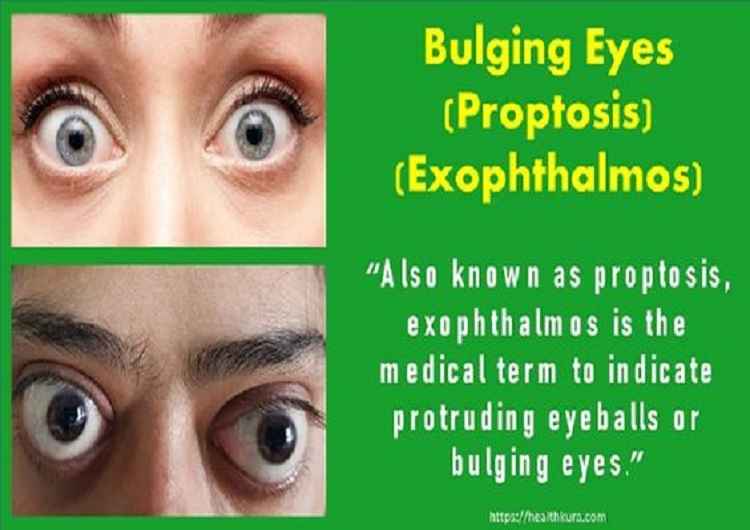
Bulging Eyes: Exophthalmos vs Proptosis
Abnormal protrusion of eyeballs in endocrine disorders especially in thyroid dysfunction is known as exophthalmos. And, abnormal bulging of eyeballs in every other dysfunction is called proptosis.
Some medical practitioners use the term “proptosis” if the protrusion of the eye globe is 18 millimeters (mm) or less while they use “exophthalmos” if the bulging of the eye is more than 18 mm. Exophthalmos comprises proptosis and lid lag.
When the volume of the orbit is decreased, the contents in the orbit are protruded anteriorly. This is called exorbitism.
Pseudoproptosis
There is no actual bulging of the eyeball in pseudoproptosis. For instance, enophthalmos of one eye may cause apparent bulging of the other eye. Similarly, the elongation of eyeballs in high myopia gives the false appearance of bulging eyes.
Types of Ocular Proptosis
Proptosis is categorized into the following groups:
- Unilateral
- Bilateral
- Acute
- Intermittent
- Pulsatile
Bulging Eyes (exophthalmos) Causes
Causes of unilateral proptosis
Congenital unilateral proptosis is seen in conditions such as dermoid cyst, orbital teratoma, and congenital cystic eyeball. Other common causes of unilateral proptosis are traumatic lesions, inflammatory lesions, cysts of orbit, tumors of the orbit, mucoceles of paranasal sinuses, circulatory disturbances, and vascular lesions.
Causes of bilateral proptosis
Developmental anomalies of the skull as seen in craniofacial dysostosis leads to bilateral proptosis. Other causes of bilateral proptosis are osteopathies, endocrinal exophthalmos (thyrotoxicosis), and inflammatory conditions such as Mikulicz’s syndrome and late stage of cavernous sinus thrombosis.
Similarly, systemic diseases like histiocytosis, systemic amyloidosis, xanthomatosis, and Wegener’s granulomatosis also leads to bilateral proptosis. Another major cause of bilateral proptosis is the tumor, like symmetrical lymphoma or lymphosarcoma.
Causes of acute proptosis
Acute proptosis, as the name suggests, develops with sudden onset. The common causes of acute proptosis are orbital hemorrhage, orbital emphysema, rupture of ethmoidal mucocele, and fracture of the medial orbital wall.
Cause of intermittent proptosis or bulging eye
The intermittent bulging eye comes and goes on its own. The common causes of intermittent proptosis are recurrent orbital hemorrhage, orbital varix, periodic orbital edema, and highly vascular tumors.
Causes of pulsating proptosis
Pulsating vascular lesions such as carotid-cavernous fistula and saccular aneurysm of ophthalmic artery cause pulsating proptosis. Conditions associated with a deficient orbital roof like meningocele, meningoencephalocele, neurofibromatosis also lead to pulsating proptosis.
Symptoms of Exophthalmos (Bulging Eyes)
- Bulging eyes
The primary complaint or main symptom of exophthalmos is bulging eyes. The bulging eye may be bilateral or unilateral depending on the cause of exophthalmos. It may be difficult to notice this sign if the proptosis is bilateral and the progression is slow.
- Eyelid swelling
Swollen eyelid is seen if the bulging eye is associated with preseptal cellulitis, orbital cellulitis, and chemosis i.e. redness and bulging of conjunctiva beneath the eyeball.
- Red-eye
In severe cases of exophthalmos, secondary exposure keratopathy and increased dryness are common due to incomplete eyelid closure. As a result, conjunctival injection increases.
- Pain
The presence of inflammation, infection, a rapidly increasing tumor, or compromised cornea gives rise to pain in bulging eyes.
- Double vision
If the action of extraocular muscles is restricted due to any cause of ptosis, it results in double vision.
- Blurry vision
There might be a blurry vision in the presence of any of these products of bulging eyes:
-exposure keratitis
-distortion of the macular region by any lesion
-optic nerve involvement
- Sensitivity to light (photophobia)
- Lacrimation
- Blindness (in optic nerve compression)
- Restriction of ocular motility
- Feeling pressure around the eye
Assessment of Proptosis/ Exophthalmos
Taking history
History taking plays a vital role in the diagnosis and management of bulging eyes. It is done to establish whether proptosis is unilateral or bilateral. Your eye doctor might ask a few questions related to the bulging eyes.
It is necessary to find out the onset, duration, and progression of the disease. You may be asked questions about the diminution of vision, color vision defect, double vision, disclosure of eyelids, association with straining, postural variation, and oral hygiene.
Clinical examination
It involves inspection, palpation, percussion, auscultation, and clinical tests. Periorbital changes should be assessed in a well-lit room.
Inspect the orbit
Look carefully for any lid swelling, incomplete lid closure (lagophthalmos), and engorged conjunctival or episcleral vessels. To locate any tenderness or masses, just palpate the orbit and examine the regional lymph nodes. Listen to the globe over the closed eyelid with a stethoscope if you suspect any lesion.
Inspect the optic nerve
To thoroughly check the optic nerve function, perform the following tests:
- Visual acuity test
- Color vision test
- Contrast sensitivity test
- Confrontational visual field test
- Pupillary reaction-to look for relative afferent pupil defect (RAPD)
Inspect the proptosis
Carefully inspect the direction of the proptosis looking from above and behind. To establish the severity of proptosis, an exophthalmometer (Hertel’s) is most commonly used. It uses a system of small mirrors to visualize the corneal apices against a scale.
If not available, a clear plastic ruler can also be used, although it is less accurate. Forward protrusion difference of 2mm between the two eyes is clinically significant. Note carefully, whether it is reducible, pulsatile. Perform extraocular motility tests to ascertain how immobile the eye is.
Investigation
Blood investigation and imaging investigation help to diagnose and manage the case of bulging eyes. The hematological investigation includes a complete hemogram, ESR, FBS/PPBS, thyroid function test (TFT), serum c-ANCA levels, and serum ANA levels. Other important tests are sputum tests for AFB and Montoux test.
X-rays should be included in the first screening imaging test. Similarly, ocular ultrasonography (both A-scan and B-scan) is a rapid, non-invasive, simple, and free-of-radiation technique that gives information about the characteristics of the lesion. Your eye doctor may recommend doing a CT scan and MRI if needed.
Bulging Eyes (Exophthalmos) Treatment
Exophthalmos treatment plan may vary depending upon the underlying cause of bulging eyes. Ophthalmologists will determine the treatment after regular monitoring of the case of proptosis. Sometimes, the bulging eyes should be monitored closely for years to determine the progression rate before deciding the treatment options.
Depending on the diagnosis, the eye doctor may recommend any of these treatment options:
- Lubricating eyedrops
- Sunglasses to reduce photophobia
- Antibiotics
- NSAIDs (non-steroidal anti-inflammatory drugs) or corticosteroids
- Immunosuppressants, such as cyclosporin
- Ocular surgery
- Chemotherapy, or radiation
- Beta-blockers or antithyroid medications in thyroid disease
- Replacement thyroid hormone in thyroid disease
Smoking increases the risk of any kind of bulging eyes. So, you should quit smoking in any type of bulging eye disease.
The available surgical treatment options in proptosis include orbital decompression, eye muscle surgery, and eyelid surgery.
If left untreated, the incomplete closure of eyelids during sleep results in dry eyes, exposure keratitis, corneal ulcer, or conjunctivitis. Rarely blindness occurs due to bulging eyes in case of compression of the optic nerve or ophthalmic artery.
So, it is important to closely monitor the bulging eyes with the help of the medical team to manage the case effectively.
You may also like
Contact Lens Comprehensive Gide
What is the Cornea of the Eye?
The white part of the Eye: Sclera
What is the Conjunctiva of the Eye?
FAQs
1. What causes bulging eyes or proptosis?
The most common cause is thyroid eye disease, also called Graves’ ophthalmopathy. In this condition, the immune system attacks the muscles and fat behind the eye. These tissues swell. The swelling pushes the eye forward. Other causes include tumors behind the eye, like hemangiomas or cancer. Infection behind the eye, called orbital cellulitis, can cause bulging. Bleeding behind the eye from injury can also cause it. Some people are born with shallow eye sockets, which makes their eyes look bulging. See a doctor if you have bulging eyes.
2. What are the symptoms of bulging eyes?
The main symptom is one or both eyes sticking out farther than normal. You may have a wide-eyed stare. You may feel pressure or pain behind your eye. Your eyes may feel dry and gritty because you cannot close them fully. You may have double vision because the muscles are swollen and not working together. Your eyelids may be red and swollen. You may have trouble moving your eyes. You may also have symptoms of thyroid disease, like weight loss, fast heartbeat, or feeling hot. If you have any of these symptoms, see a doctor.
3. How are bulging eyes treated?
Treatment depends on the cause. For thyroid eye disease, doctors first treat the thyroid problem. They may give you medication to lower your thyroid hormone levels. For eye symptoms, they may prescribe steroid eye drops or steroid pills. These reduce swelling. If your eyes are very dry, you will need artificial tears. If you have double vision, you may need prism glasses. For severe cases, surgery can help. Orbital decompression surgery makes the eye socket bigger so the eye can move back. Eyelid surgery can help you close your eyes fully. See a specialist for the best treatment.