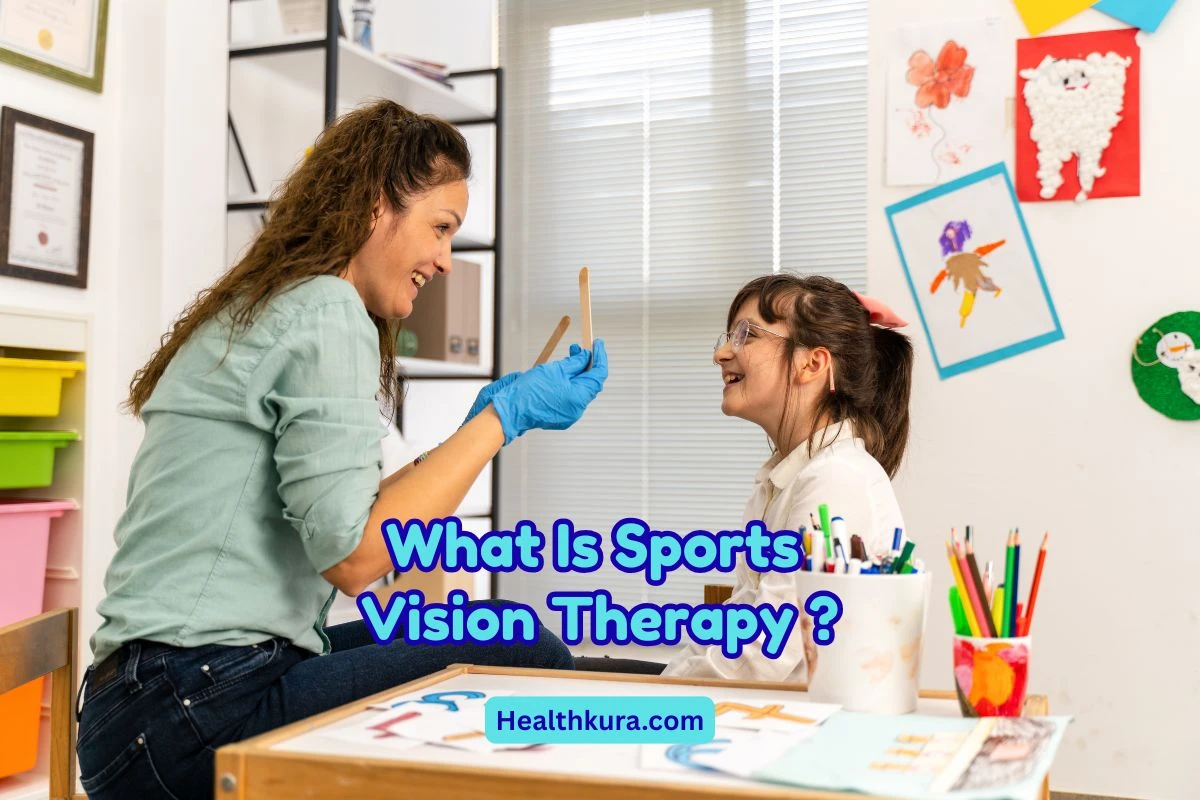
You spend hours perfecting your swing, your footwork, your throwing mechanics. You watch film. You lift weights. And, you sleep eight hours and eat clean. But when a curveball breaks late across the plate, or a defender appears out of nowhere, none of that preparation matters if your visual system cannot keep up.
That is exactly where sports vision therapy comes in. It is not about whether you need glasses. It is about whether your eyes and brain are working together at the level that elite performance demands. Most athletes never even know this type of training exists, let alone how dramatically it can change their game.
This article breaks down everything you need to know about sports vision therapy: what it is, how it works, which visual skills it targets, who stands to benefit most, and how to take the first step toward sharper, faster, more reliable vision on the field.
What Is Sports Vision Therapy?
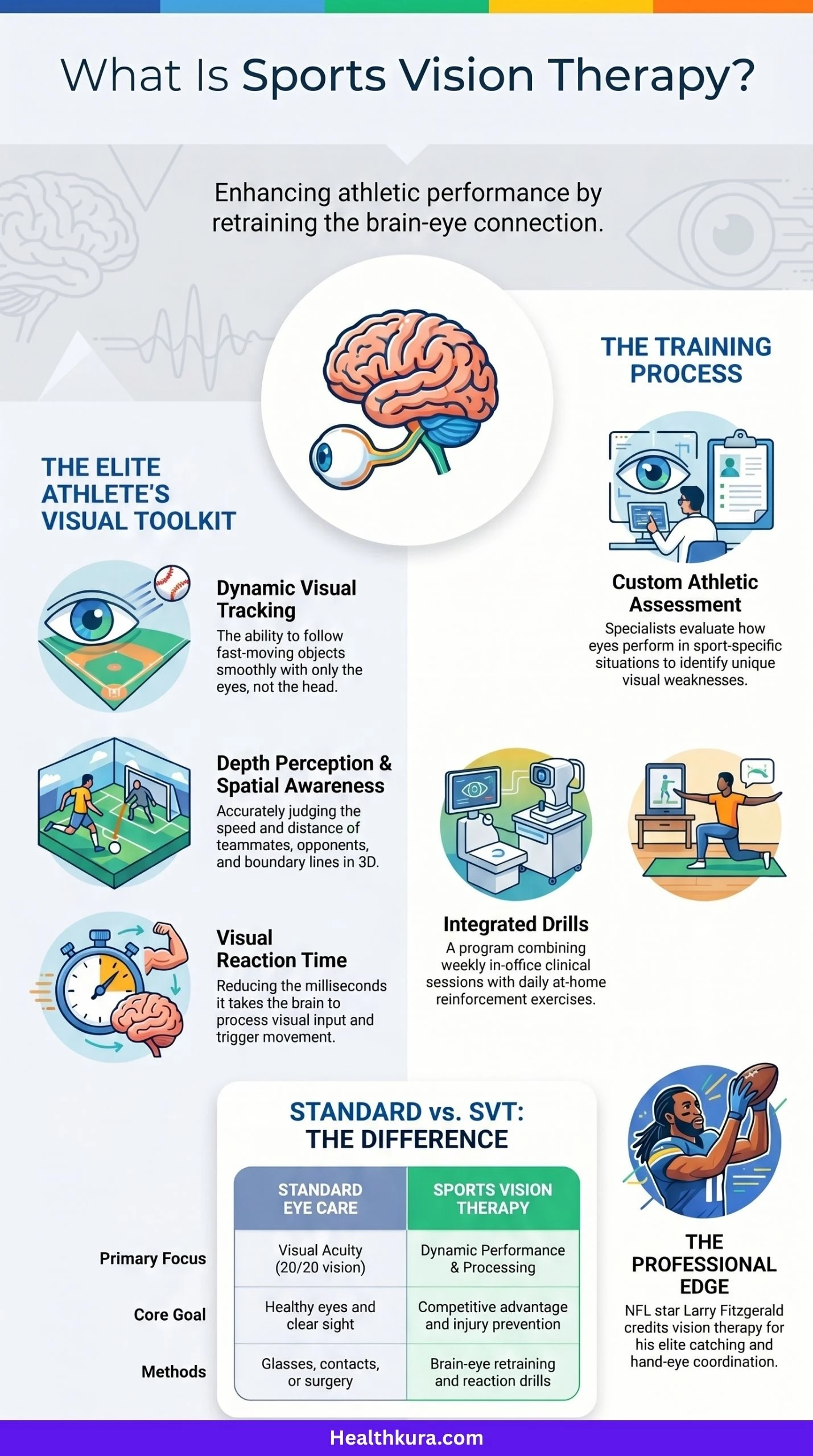
Sports vision therapy (SVT) is a specialized discipline within optometry. It goes well beyond standard eye care. While a regular eye exam checks for clarity of vision and the health of your eyes, sports vision therapy focuses on training the dynamic visual skills that directly affect athletic performance.
A sports vision optometrist or certified sports vision specialist designs personalized training programs to help athletes develop and refine specific visual abilities. These include hand-eye coordination, peripheral vision, depth perception, spatial awareness, and reaction time. The training is tailored to the demands of each individual sport and athlete.
Think about what separates good athletes from great ones. Often, it is not just raw physical ability. It is the ability to read the field faster, track a moving object with precision, and make the right decision in a fraction of a second. Visual performance drives those decisions. SVT exists to sharpen that performance at the neurological level.
According to the American Optometric Association, vision is the dominant sense in most sports. Yet it remains one of the most undertrained aspects of athletic preparation. Sports vision therapy addresses that gap directly and systematically.
How Sports Vision Therapy Differs from a Standard Eye Exam
Many people assume that having 20/20 vision means their eyes are ready for peak athletic performance. That assumption is wrong. Visual acuity, which is what a standard eye exam measures, tells you how clearly you can see stationary letters on a chart. It says nothing about how well your eyes track a moving object, how quickly your brain processes visual input, or how accurately your body responds.
Sports vision therapy targets dynamic visual function, the kind that kicks in during live competition. A standard comprehensive eye exam is still essential and should be completed before beginning any SVT program. But once your eye doctor rules out refractive errors and eye health issues, sports vision training picks up where the exam leaves off.
The two forms of care complement each other. SVT does not replace routine eye care. It builds on it. Your sports vision specialist uses the results of your comprehensive exam as a foundation, then layers in sport-specific visual assessments to identify which skills need the most development.
The Core Visual Skills Targeted in Sports Vision Therapy
SVT zeroes in on the visual abilities that make the biggest difference between a good play and a great one. Here is a detailed look at each skill and why it matters.
Hand-Eye Coordination
Hand-eye coordination is the brain’s ability to process what the eyes see and translate that information into precise physical movement. It is the reason a tennis player can position their racket exactly where a 120 mph serve is heading, or a baseball batter can time their swing to make contact with a 95 mph fastball.
The eyes capture visual data, the brain interprets it, and the hands execute the appropriate motor response. When this chain works efficiently, performance improves across nearly every sport. When it breaks down, errors multiply.
SVT specialists train this skill using reaction drills and tools like sensor-pad touch boards. In a typical drill, a board covered with sensor-activated circles is placed at arm’s length from the athlete. Circles light up one at a time, and the athlete must touch each lit circle as quickly as possible. The speed and accuracy of these responses are tracked and used to measure progress over time.
Improved hand-eye coordination directly translates to more accurate hitting, throwing, and catching in competition.
Depth Perception
Depth perception, also called stereopsis, is the brain’s ability to judge how far away something is. It depends on binocular vision, your brain’s capacity to integrate the slightly different images captured by each eye into one unified three-dimensional image.
Sports vision specialists recognize two types of stereopsis. Dynamic stereopsis applies to catching sports with a moving target. It helps you judge when to jump for a rebound, when to close your glove around a baseball, or when to time a header in soccer. Static stereopsis applies to sports where the target is fixed, such as golf or archery, where precise distance judgment is critical to accuracy.
Research published in the International Journal of Environmental Research and Public Health confirmed that stronger stereopsis correlates with better visuomotor integration in athletes. In simple terms, better depth perception helps athletes respond faster and more accurately to their targets.
One accessible exercise for improving depth perception is the pencil push-up drill, which involves repeatedly shifting focus from a near object to a distant one. This trains both eyes to converge and diverge together, which improves the brain’s ability to build accurate three-dimensional spatial maps.
Visual Tracking
Visual tracking is the smooth, continuous following of a moving object using only the eyes, without moving the head. It is what allows you to follow the arc of a golf ball off the tee, trace the path of a hockey puck along the boards, or watch a basketball from the moment it leaves a shooter’s hands.
Elite athletes do not just track one object. They practice multiple object tracking, the ability to monitor several moving elements simultaneously. A wide receiver in football, for example, must simultaneously track the quarterback’s release point, the ball’s trajectory, and the positioning of at least one or two defenders, all while running a designated route at full speed. That is an extraordinary visual and cognitive load.
Strong tracking skills improve more than just physical performance. Research shows that visual tracking therapy enhances cognitive skills including memory, problem-solving, decision-making, and learning. The brain circuits involved in smooth visual pursuit overlap significantly with those used for executive function.
Peripheral Vision
Peripheral vision is your side vision, what you can see without turning your head. In a fast-paced game, your central vision is locked onto one object while your peripheral vision fills in critical information from the surrounding environment.
A football player uses peripheral vision to sense a defender approaching from the side without losing sight of the ball. A volleyball player uses it to track teammates and anticipate where the next set is heading. A basketball point guard uses it to find an open cutter while driving through traffic.
Sports vision therapy enhances peripheral awareness through wide-field awareness drills and reaction light technology. These tools present stimuli at the edges of the visual field and train athletes to respond faster without losing focus on their central target. Research published in Bioengineering in June 2023 found measurable improvements in manual reaction time for handball, basketball, and volleyball players following peripheral vision training using FitLight technology.
Reaction Time
Reaction time is how quickly your brain processes what your eyes see and triggers a motor response. In competitive sport, a difference of even 30 milliseconds can determine whether you block a goal, hit a pitch, or absorb a punch.
A baseball batter facing a 95 mph fastball has approximately 400 milliseconds from the moment the pitch leaves the pitcher’s hand until it crosses the plate. The batter needs roughly 150 milliseconds just to swing. That leaves almost no room for hesitation. Every millisecond of faster reaction time is competitive gold.
SVT specialists use strobe light training, rapid-response games, and reactive technologies to train athletes to process visual information faster. These tools force the brain to make quicker decisions under increasingly challenging conditions, gradually compressing the time between perception and action.
The Broader Benefits of Sports Vision Therapy
Performance improvement is the most obvious reason athletes pursue SVT. But the benefits extend well beyond playing better.
Injury prevention is one of the most underappreciated outcomes. Athletes with stronger peripheral vision and faster reaction times are better equipped to avoid collisions, spot hazards on the field, and react to unexpected situations before they become dangerous.
Concussion detection and recovery is another critical area. Sports vision specialists are trained to identify vision-related symptoms that may indicate an undiagnosed concussion, such as difficulty tracking, double vision, or coordination issues. After a concussion or traumatic brain injury, the eyes and brain often lose their normal synchronization. SVT provides a structured path to restoring that connection and safely returning an athlete to competition.
Confidence is also a real, measurable benefit. When an athlete consistently makes visual errors under pressure, doubt accumulates. When those errors are corrected through structured training, confidence returns naturally. Seeing better leads to playing better, which leads to believing more.
Beyond sports, SVT improves overall cognitive function. The visual skills trained through SVT overlap with skills used in everyday life, from driving and reading to spatial navigation and quick decision-making.
How a Sports Vision Therapy Program Actually Works
The process begins with a sports-specific vision assessment. A qualified sports vision optometrist or specialist evaluates how your eyes function in conditions that mimic your sport. This goes far beyond reading an eye chart. The assessment might measure how quickly you can track a moving target, how well your eyes converge under fatigue, or how accurately you perceive depth in a dynamic environment.
From there, the specialist builds a custom training plan based on your sport, your vision weaknesses, and your performance goals. Most programs combine in-office sessions with structured at-home exercises. In-office sessions allow athletes to use specialized clinical equipment. At-home drills reinforce progress between visits.
Program lengths vary. Some athletes complete their goals in a few weeks. Others with more complex needs, or those recovering from injury, may train for several months. Throughout the program, the specialist monitors progress closely and adjusts the plan as skills improve.
The training is progressive. As an athlete gets better, the difficulty of the drills increases. This ensures that the visual system is always being challenged and that gains keep coming.
Who Should Consider Sports Vision Therapy?
Almost any athlete can benefit from sports vision training, regardless of age, level, or sport. Youth athletes preparing for tryouts or competing for scholarships can gain a meaningful edge. Amateur athletes who have plateaued can find new performance gains they did not know were available to them. Professional athletes at the highest level use SVT to stay sharp and maintain their competitive advantage.
Post-injury athletes stand to gain significantly. After a concussion or eye injury, the brain and visual system often need deliberate retraining to reconnect. SVT provides a structured, evidence-based path through that recovery.
Non-athletes and retired professionals are also excellent candidates. The skills developed through SVT, including faster reaction time, better spatial awareness, and sharper peripheral awareness, all carry over into daily life. Driving, reading, and navigating complex environments all become easier when your visual system is performing at its best.
Signs That Sports Vision Therapy Might Be Right for You
Certain patterns in your performance can signal that your visual system is limiting your athletic potential. You might be a strong candidate for performance vision therapy if you regularly struggle to follow fast-moving objects like a speeding ball or puck. Difficulty with this could point to weaknesses in visual tracking.
Frequent misses or errors during play, especially when catching or judging distances, often indicate depth perception deficits. These kinds of errors tend to feel mysterious because the athlete works hard and is physically capable, but the visual system is not giving the brain accurate enough information.
If you have experienced a concussion, any ongoing visual symptoms like blurriness, dizziness, or difficulty focusing during activity should be evaluated by a sports vision specialist. These are signs that your visual and neurological systems need structured rehabilitation.
Inconsistent performance from game to game, when you sometimes see the field brilliantly and other times seem to miss what should be obvious, can also be a sign that your visual system is undertrained. Consistency in performance often follows from consistency in visual function.
How to Get Started with Sports Vision Therapy
The right first step is a comprehensive eye exam with a licensed optometrist. This rules out any underlying refractive errors or eye health issues that need to be corrected before training begins. If you wear glasses or contact lenses, make sure your prescription is current and accurate.
After your eye health is confirmed, ask your eye doctor or coach for a referral to a qualified sports vision specialist. The American Optometric Association and the International Sports Vision Association (ISVA) are both reliable starting points for finding credentialed practitioners.
From there, expect an initial assessment appointment that helps the specialist understand your visual baseline and your sport-specific needs. Your custom program will be built from that data, and your training will begin.
Consistency matters. Like physical training, visual training requires regular practice and progressive challenge to produce results. Athletes who commit to their SVT programs and do their at-home drills between clinic visits see the strongest gains.
A Final Note
Sports vision therapy is one of the most effective and underutilized tools in athletic development. It addresses a fundamental truth that most training programs ignore: your performance is only as good as the visual information your brain receives and processes. If your eyes are not tracking, perceiving, and reacting at peak efficiency, every other training advantage you have built is working with incomplete data.
The good news is that visual skills can be trained, just like strength, speed, and endurance. A qualified sports vision specialist can identify exactly where your visual system is underperforming and design a structured program to fix it. Whether you are a youth athlete looking for an edge, a professional trying to extend a career, or someone recovering from a concussion, SVT offers measurable, meaningful improvements.
If you are serious about reaching your athletic ceiling, consider scheduling a sports vision assessment as your next step. Talk to your eye doctor or coach about finding a certified sports vision optometrist in your area. And make sure your next comprehensive eye exam is on the calendar, because great vision training starts with great eye health.
Sources
- American Optometric Association (AOA) – Sports & Performance Vision: https://www.aoa.org/healthy-eyes/caring-for-your-eyes/sports-and-performance-vision
- International Sports Vision Association (ISVA): https://www.sportsvision.org
- UC Berkeley Herbert Wertheim School of Optometry & Vision Science – Sports Vision Clinic: https://optometry.berkeley.edu/clinics/sports-vision-clinic/
- Vision Therapy Canada – Sports Vision Training: https://www.visiontherapycanada.com/sports-vision
- Journal of Functional Morphology and Kinesiology – Role of Sport Vision in Performance (May 2024): https://www.mdpi.com/journal/jfmk
- International Journal of Environmental Research and Public Health – Stereopsis in Sports (October 2021): https://www.mdpi.com/ijerph/
- Journal of Vision – Visuomotor Predictors of Batting Performance in Baseball (March 2021): https://jov.arvojournals.org
- Bioengineering (MDPI) – Impact of Peripheral Vision on Manual Reaction Time (June 2023): https://www.mdpi.com/journal/bioengineering
- NAPA Center – Activities to Improve Visual Scanning and Tracking: https://napacenter.org
- International Review of Sport and Exercise Psychology – Training Vision in Athletes (December 2024): https://www.tandfonline.com/journals/rirs20