
You pick up a bottle of eye drops. The cap is a certain color. That color is not random. It tells you what type of eye drops are inside. The color code is used around the world. It helps patients and doctors quickly identify the right drops.
The color code was created by eye drop manufacturers. It is not a law. But most companies follow it. The colors help prevent dangerous mistakes. Using the wrong eye drops can hurt your eyes.
Red caps are for antibiotic eye drops. Pink caps are also for antibiotics, but different ones. Orange caps are for anti-inflammatory drops. Green caps are for glaucoma drops that lower eye pressure. Yellow caps are for artificial tears. White caps can be for many different types. Blue caps are usually for allergy drops.
This color code is not perfect. Different brands sometimes use different colors. Always read the label before using any eye drop. Never rely on the cap color alone.
Let’s explore the eye drop cap color chart, including red, pink, orange, green, and all the other colors. We will learn what each color usually means.
Eye Drop Cap Color Uniform Code
The prescription eye drop cap colors vary on the basis of their therapeutic class. Are you not surprised to know this secret about eye drop bottle lid colors? Today, we will be decoding the secret and you will know everything about the ophthalmic eye drop cap color chart.
Eye drop cap colors are not the manufacturer’s design choice. The American Academy of Ophthalmology (AAO) endorses a policy to maintain uniform color-code topical ocular medication bottle caps.
This policy on uniform eye drop cap colors, first published in 1983, came about from reports to the AAO and to the National Registry of Drug-Induced Ocular Side Effects. There were serious adverse events occurring because patients had a difficult time telling their eye drop cap color. So, the Food and Drug Administration (FDA) in coordination with the AAO’s Committee developed a uniform color-coding system.
According to the AAO, the specific Pantone colors were assigned to defined classes of eye drops according to the nature of the disease being treated, the product’s side-effect profile, and the risk of serious sequelae if an eye drop is inadvertently switched with another.
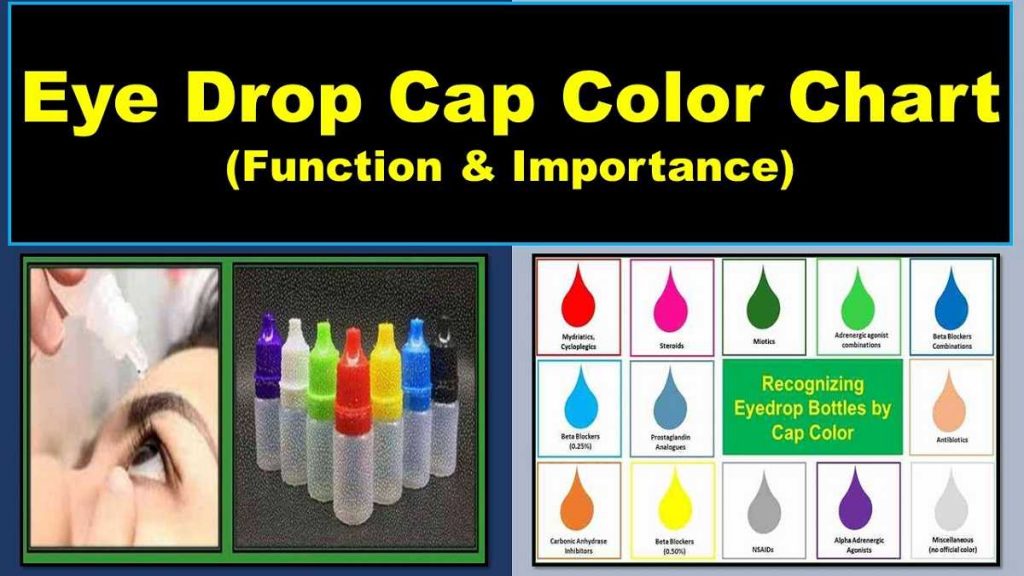
The Utility of Uniform Eye Drop Cap Color Chart
Everybody is aware of the adverse side effects incorrect ocular medications can have on the ocular system and overall body functioning. So, the uniform color-coding system for topical eye drops helps patients to distinguish among various medications. This drastically minimizes the risk of selecting the wrong eye medication by the patient.
The highest population to mix up eye drops are those with vision problems. So, the eye drop cap color chart serves as a safeguard against human error. Memorize these color schemes as a safety guard against your instilling the wrong eyedrop in your eyes.
If you go to the eye clinic or medical store and suddenly forget the name of the eye drop you were using, then remembering the eye drop cap color helps clinicians and pharmacists to make an idea about the particular eye medication you were using.
Stay together till the end as we are going to present to you the very simplified and pictorial representations of the commonly prescribed eye drop cap color chart. So, the next time you visit the eye clinic you can tell about your medication to your eye doctor using the phrases “the eye drops with red cap”, “eye drop with yellow cap”, or “prescription eye drops with pink cap” if you have already lost the bottle or prescription sheet.
Eye Drop Cap Color Chart

Prescription eye drop cap colors and common uses
Eye Drops with Red Cap – Mydriatics and Cycloplegics
Phenylephrine, tropicamide, atropine, cyclopentolate, cyclomydril

Uses
- Pupil dilation during a routine eye exam
- Reduce pain in ocular inflammation
- Diagnostic test for Horner’s syndrome, Phenylephrine test (conjunctivitis, scleritis or episcleritis)
Mode of Action (MOA)
» Either a disruption of the parasympathetic nerve supply to the iris constrictor muscle (which normally constricts the pupil) or overactivity of the sympathetic nervous system to the iris dilator muscle.
Prescription Eye Drops with Pink Cap – Steroids (Anti-Inflammatory)
Alrex/Lotemax (loteprednol etabonate, Durezol (difluprednate), FML (fluoromethalone), Pred Forte/Pred Mild (prednisolone acetate), Vexol (rimexolone)
(Note: Some steroid eye drops have white cap color)

Uses
To treat seasonal allergic conjunctivitis, ocular inflammation such as uveitis.
Eye Drops with Orange Cap Color – Carbonic Anhydrase Inhibitors
Dorzolamide (Trusopt), brinzolamide (Azopt)

Uses
Glaucoma treatment
Mode of Action (MOA)
» Lowers intraocular pressure by decreasing production of aqueous humor in the eye.
Eye Drops with Yellow Cap or Light Blue Cap Color – Beta Blockers
- A light blue cap (0.25%) – has a lower concentration of the drug
- A yellow cap (0.50%) – has a higher concentration of the drug
Timolol (Timoptic), levobunolol (Betagan), Betaxolol (Betoptic) – light blue top

Uses
Glaucoma treatment
Mode of Action (MOA)
» Inhibit beta 1 and beta 2 adrenergic receptors located on the ciliary epithelium, thus preventing synthesis of cyclic adenosine monophosphate (c-AMP), which lowers the intraocular pressure by decreasing production of aqueous humor in the eye.
Eye Drops with Light Green Cap Color – Adrenergic Agonist Combinations
Simbrinza (brinzolamide-brimonidine)

Uses
Glaucoma treatment
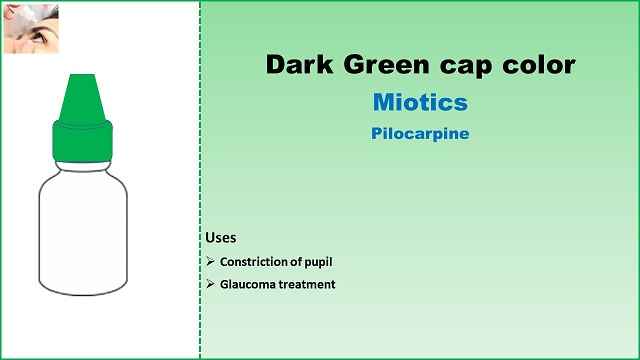
Eye Drop with Dark Green Cap Color – Miotics
Pilocarpine
Uses
Constriction of pupil
Glaucoma treatment
Mode of Action (MOA)
» Cholinergic agonists (parasympathomimetics) acts by stimulating the muscarinic receptors located on the pupillary sphincter muscle and ciliary body to contract. This contraction pulls the peripheral iris away from the trabeculum (in angle-closure) and lower intraocular pressure by increasing aqueous outflow through the trabecular meshwork.
Eye Drops with Turquoise Cap Color – Prostaglandin Analogues
Lumigan (bimatoprost), Travatan Z (travoprost), Xalatan (latanoprost)

Uses
Glaucoma treatment
Mode of Action (MOA)
» Lowers intraocular pressure by increasing uveoscleral outflow of aqueous humor.
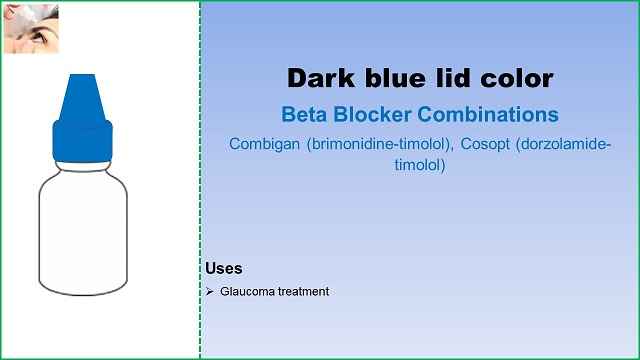
Dark Blue Cap Eye Drops – Beta Blocker Combinations
Blue cap eye drops include Combigan (brimonidine-timolol), Cosopt (dorzolamide-timolol)
Uses
Glaucoma treatment
Purple Cap Eye Drops– Adrenergic Agonists
Purple cap eye drops include Alphagan P (brimonidine), Lumify (brimonidine)

Uses
Glaucoma treatment
Mode of Action
» lowers intraocular pressure by decreasing production of aqueous humor in the eye,
» increasing uveoscleral outflow of aqueous humor from the eye.
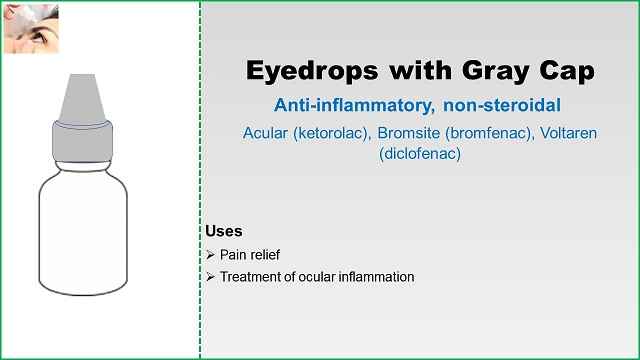
Eye Drops with Gray Cap – Anti-Inflammatory, Non-Steroidal
Acular (ketorolac), Bromsite (bromfenac), Voltaren (diclofenac)
Uses
Pain relief
Treatment of ocular inflammation
Eye Drops with Tan Cap Color – Antibiotics
Ciloxan (ciprofloxacin), Moxeza/Vigamox (moxifloxacin), Ocuflox (ofloxacin)

Uses
Treatment of bacterial infections (such as conjunctivitis and corneal ulcers)
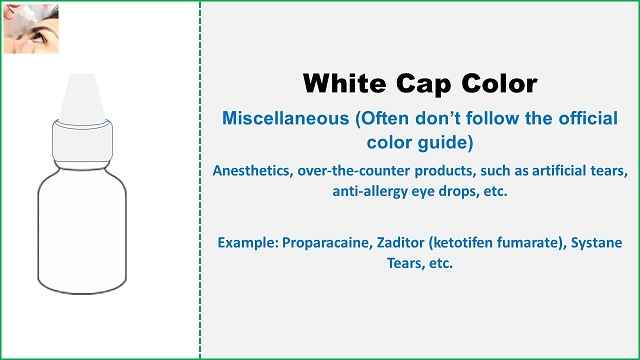
Eye Drops with White Cap Color – Miscellaneous (Often don’t follow the official color guide)
Anesthetics, over-the-counter products, such as artificial tears, anti-allergy eye drops, etc.
Example: Proparacaine, Zaditor (ketotifen fumarate), Systane Tears, etc.
If you are an eye care practitioner, ask the patient about the eye drop cap color if they forget to tell you the name of the eyedrop they are using. The patient will find it easier to recall the eye color immediately. This is one of the best approaches to verify a patient’s compliance with treatment.
Exception in eye drop cap color does exist. AAO suggests considering alternative identification technologies, which further reduce the likelihood of drug errors.
Source
YOU MAY ALSO LIKE Double Vision (Diplopia): Causes, Tests, and Treatment
FAQs
1. What do red and pink eye drop caps mean?
Red and pink caps usually mean antibiotic eye drops. These drops kill bacteria. They are used for bacterial eye infections like pink eye or styes. Different antibiotics have different colors. Red caps are often for stronger antibiotics. Pink caps are often for milder antibiotics. Examples include erythromycin (red cap) and gentamicin (pink cap). Always read the label to be sure. Using antibiotic drops when you do not need them can cause resistance.
2. What do green and blue eye drop caps mean?
Green caps usually mean glaucoma drops. These drops lower pressure inside the eye. They are used to treat glaucoma, a disease that damages the optic nerve. Green caps can be for several different types of glaucoma drops, including beta-blockers and prostaglandins. Blue caps usually mean allergy drops. These drops block histamine, the chemical that causes itching and redness. They are used for eye allergies from pollen, dust, or pet dander. Blue caps can also be for non-steroidal anti-inflammatory drops.
3. What do yellow and orange eye drop caps mean?
Yellow caps usually mean artificial tears. These drops lubricate the eye. They are used for dry eye. Artificial tears are safe to use as often as you need. Orange caps usually mean anti-inflammatory drops. These drops reduce swelling and inflammation. They can be steroids or non-steroidal drops. Orange caps are often used after eye surgery or for conditions like uveitis. Never use steroid drops without a prescription. They can make some eye infections much worse. Always read the label before using any eye drop.