When pressure builds up inside the skull, it is called increased intracranial pressure or ICP. This is a medical emergency. The brain is squeezed inside the hard skull. If the pressure gets too high, it can cause permanent brain damage or death. The body tries to fight back. Its response is called Cushing’s Triad.
Cushing’s Triad is a set of three vital sign changes. They happen together when ICP is dangerously high. The body is trying to keep blood flowing to the brain. The three signs are: high blood pressure, a slow heart rate, and irregular breathing.
The high blood pressure pushes blood into the brain. The slow heart rate is a reflex response to the high pressure. The irregular breathing means the brain stem is being compressed. This is a very bad sign.
Cushing’s Triad is named after Harvey Cushing, a famous brain surgeon. He described these signs in the early 1900s. Today, doctors and nurses watch for these signs in patients with head injuries, brain tumors, or brain bleeds.
Let’s explore Cushing’s Triad in ICP, including its pathophysiology, a helpful mnemonic, and why it is so important to recognize.

What is Cushing’s Triad?
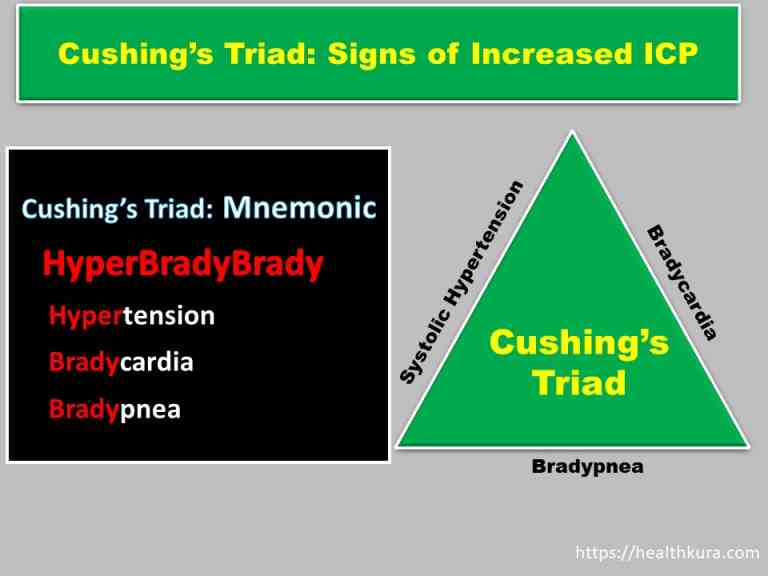
Also known as the increased ICP triad, Cushing’s triad is defined as a set of three clinical signs of increased intracranial pressure (ICP), which includes bradycardia, bradypnea, and hypertension.
Cushing’s triad is the manifestation of Cushing reflex (also referred to as the Cushing effect, the Cushing reaction, the Cushing’s phenomenon, or Cushing’s Law) – physiological nervous system response to increased intracranial pressure.
Cushing’s triad is also known as the brain herniation triad. It is the signs/symptoms developed by Cushing’s reflex.
Cushing Triad is important, but a late sign of raised intracranial pressure (ICP). The doctors, paramedics, and nurses must be looking for this condition in patients who have had a recent head injury, brain injury, neurosurgery, or anyone with a suddenly altered level of consciousness. It usually serves as a warning sign of brain herniation
Cushing’s reflex (and Cushing’s triad) can also be seen in the intravenous administration of epinephrine and other drugs of similar nature.
Whenever a Cushing reflex occurs, there is a high probability of death in seconds to minutes. As a result, a Cushing reflex indicates a need for immediate care. Since its presence is a good detector of high ICP, it is often useful in the medical field, particularly during surgery.
Components of Cushing Triad Nursing Guide USMLE
Cushing’s triad is a clinical triad that consists of the following vital signs:
- Bradypnea – a change in respiration, often irregular and deep, such as Cheyne stokes
- Systolic hypertension– Widening pulse pressure (the difference between systemic and diastolic blood pressure). Systolic blood pressure will usually be over 180mmhg
- Bradycardia (slow heart rate) <50bpm
Other Signs and Symptoms of ICP (Cushing’s triad)
Along with the 3 primary vital signs of Cushing’s triad, the following signs and symptoms are also common in ICP.
- Headache
- Fixed dilated pupil (unilateral in early-stage, bilateral in the late stage of brain herniation)
- Diplopia (double vision)
- Seizures
- Nausea and vomiting
- ALOC (altered level of consciousness)
History and Etymology of Cushing Triad
The phenomenon of Cushing’s triad was first described by an American neurosurgeon, Harvey Williams Cushing (born April 8, 1869, Cleveland—died Oct. 7, 1939, New Haven, Conn., U.S.) in 1901. He was the leading neurosurgeon of the early 20th century. Cushing’s Triad is named after him.
Harvey Williams Cushing graduated from Harvard Medical School in 1895 and then studied for four years at Johns Hopkins Hospital, Baltimore.
He worked as a surgeon at Johns Hopkins from 1902 to 1912 and thenceforth he was surgeon-in-chief at the Peter Bent Brigham Hospital in Boston and professor of surgery at the Harvard Medical School. He joined the faculty of Yale University in 1933.
Cushing developed several operating procedures and techniques that are still basic to the surgery of the brain. He became the leading expert in the diagnosis and treatment of intracranial tumors.
His research on the pituitary body (1912) gained him an international reputation, and he was the first to ascribe to pituitary malfunction a type of obesity of the face and trunk now known as Cushing’s disease, or Cushing’s syndrome.
He wrote numerous scientific works and received the Pulitzer Prize in 1926 for his Life of Sir William Osler (1925).
Causes of Cushing’s Triad
The immediate cause of Cushing’s triad is increased intracranial pressure. There are many conditions to increase ICP. Common causes are:
- Brain tumor
- Traumatic brain injury
- Stroke
- Seizure
- Aneurysm rupture and subarachnoid hemorrhage
- Encephalitis (irritation and swelling, or inflammation, of the brain)
- Hydrocephalus (increased fluid around the brain)
- Hypertensive brain hemorrhage
- Intraventricular hemorrhage
- Meningitis
- Subdural hematoma
- Epidural hematoma
Traumatic Brain Injury and Cushing’s Triad
Traumatic brain injury (TBI) is a serious global public health problem. Early diagnosis and management of severe TBI are crucial to reducing mortality and morbidity.
The efficacy of intracranial pressure monitoring in pediatric patients with severe TBI remains controversial; however, intracranial hypertension is associated with high mortality and worse neurological outcomes.
If intracranial pressure increases after TBI, systemic blood pressure rises as a compensatory mechanism to maintain cerebral perfusion pressure.
Cushing’s triad of respiratory irregularity, hypertension, and bradycardia is a classic sign of intracranial hypertension.
Hypotension in pediatric patients with severe TBI is also associated with poor outcomes due to decreased cerebral perfusion pressure. (Cerebral hemodynamic predictors of poor 6-month Glasgow Outcome Score in severe pediatric traumatic brain injury.
A study “Cushing’s sign and severe traumatic brain injury in children after blunt trauma: a nationwide retrospective cohort study in Japan” done by Tetsuya Yumoto et. al. concluded that Cushing’s triad after blunt trauma was significantly associated with BI-NSI in school-age children and young adolescents.
Cushing’s Triad Pathophysiology (Patho of Cushings triad)
How increased ICP leads to systolic hypertension?
Traumatic brain injury and ICP leads to cerebral ischemia as a result of hypoxia and decreased cerebral perfusion pressure (CPP). To compensate for the hypoxia the activated sympathetic nervous system stimulates alpha 1 and beta 1 adrenergic receptors.
The brain thinks it is helping but can actually worsen the problem. Increased blood flow to the brain causes further bleeding, swelling, and resulting ICP. The compensatory mechanisms get caught in a continuous positive feedback loop.
The body attempts to maintain mean arterial blood pressure (MABP) and cerebral perfusion pressure (CPP).
MABP = Diastolic BP + (Systolic BP – Diastolic BP)/3
CPP = MABP – CP
Normal MABP is 70-100 mmHg and normal ICP is 0-15 mmHg. Herniation occurs at a pressure above 25 mmHg. Normal CPP is 50-70 mmHg.
Why there is a slow heart rate (bradycardia)?
Bradycardia is another vital sign of Cushing’s triad. Increased ICP stimulates the vagus nerve, which contributes to a drop in the heart rate. In case of severe herniation, pressure on the medulla oblongata can cause a decrease in heart rate as well.
What causes irregular respirations?
Increased systolic blood pressure and increased intracranial pressure give rise to brain herniation. The brain herniation exerts pressure on the medulla oblongata (brain stem) – the respiratory center of the brain.
The continuous pressure on it disrupts the function of the medulla oblongata and as a consequence, respirations become irregular. The disturbed respiration patterns commonly seen in Cushing’s triad are:
- Increase and decrease in the rate of respiration with periods of apnea
- Cheyne stokes respiration
- “Pre death” pattern
- Prolonged inspiratory phase followed by a shortened expiratory phase
- Biot/Ataxic Respirations
- Irregular with episodes of apnea
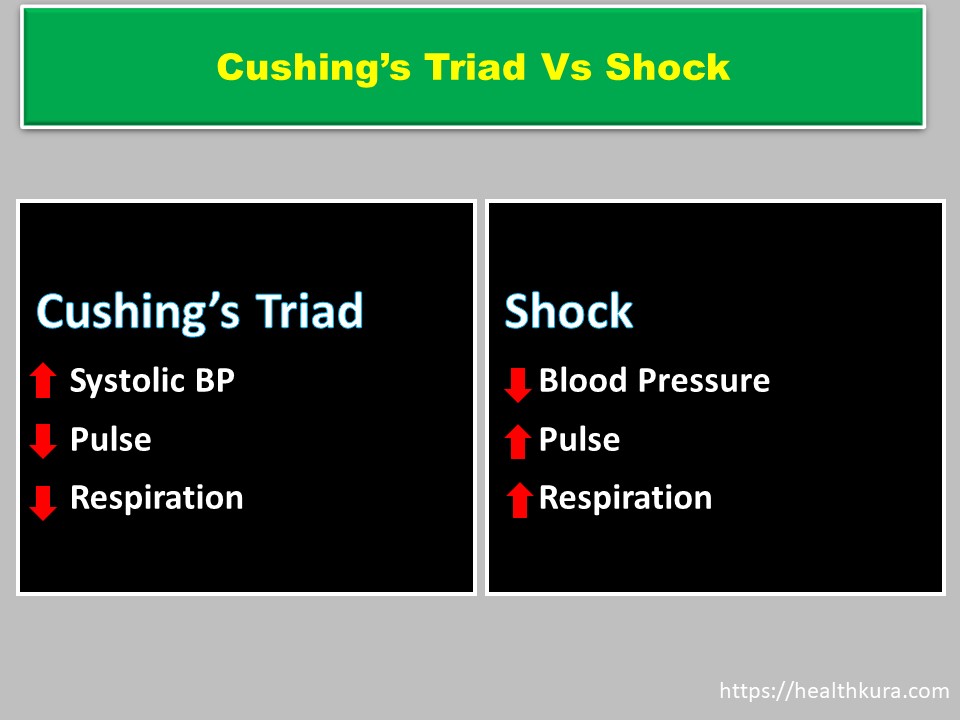
Cushing Triad Vs Shock
The best trick for remembering Cushing’s triad is to think of it as the opposite of body response to shock. In shock, there will be decreased blood pressure (hypotension), tachycardia, and tachypnea.
But in Cushing’s triad increased systolic blood pressure (hypertension), bradycardia, and irregular respirations are common.
Cushing’s Triad Treatment
Best and the only treatment for any patient with ICP/Cushing’s Triad is rapid transport to the definitive care/surgery unit because it is a medical emergency. The maximum on-scene time should be limited to 10 mins. If ICP is accompanied by an active seizure, it should be treated.
Spinal Precautions
Patients presenting with Cushing’s Triad have a high incidence of concomitant spinal cord injuries. It is necessary to maintain manual spinal immobilization until fully c-spined.
Some studies have found that the placement of a c collar can cause an increase in ICP. C collars are generally not form-fitting as it is placed too tightly which might reduce venous blood return away from the brain.
Oxygenation
Maintaining ETCO2 of 35-40 is vital as ETCO2 less than 25 increases the chance of mortality. As the patient can’t regulate breathing, he should be assisted in ventilation.
The patient with Cushing’s triad is likely to be completely unresponsive and the intubation may become difficult or impossible. Try to place the ET tube if possible.
Hypotension
Hypotension is unlikely in the patient with Cushing’s triad. Any patient with other signs of ICP that presents with hypotension should raise your suspicion of Hypovolemia, internal or external hemorrhage, spinal injury, or distributive shock.
Posture and Positioning
The patient with Cushing’s triad should be positioned with the head and trunk elevated 30-45 degrees to assist with the venous return from the head. Similarly, patients on a backboard should be elevated 15-30 degrees to facilitate drainage.
Studies have suggested the use of chemical sedation in patients that are aggressive or agitated due to head injury. Research has shown that increased stress and activity will increase ICP.
Cushing’s Triad Mnemonic
Let’s summarize Cushing’s triad in increased intracranial pressure (ICP) with the following question:
Question 1
Which of the given options best describes Cushing Triad?
Answer Choices
- Hypertension, JVD, muffled heart sounds
- Hypotension, JVD, muffled heart sounds
- Hypertension, bradycardia, irregular breathing
- Fever, Pain, Jaundice
Explanation
The Correct Answer is C – Hypertension, bradycardia, irregular breathing
Answer A – is incorrect. Cushing’s triad includes hypertension, bradycardia, irregular breathing
Answer B – is incorrect. It describes Beck’s Triad in pt. with cardiac tamponade.
Answer D – is incorrect. It describes Charcot’s Triad in pt. with ascending cholangitis
YOU MAY ALSO LIKE: Dots and Spots in Eyes (Ophthalmology)
Sources
- Ogilvy, CS; Dubois AB (1987). “Effect of increased intracranial pressure on blood pressure, heart rate, respiration and catecholamine levels in neonatal and adult rabbits”. Biology of the Neonate. 52 (6): 327–336. doi:10.1159/000242728. PMID 3435736.
- Ayling, J (2002). “Managing head injuries”. Emergency Medical Services. 31 (8): 42. PMID 12224233.
- Cushing, H (1901). “Concerning a definite regulatory mechanism of the vasomotor centre which controls blood pressure during cerebral compression”. Bull Johns Hopkins Hosp. 12: 290–2.
- Caroline, Nancy (2013). Emergency Care in the Streets (7th ed.). Jones and Bartlett Learning. p. 1665. ISBN 978-1-4496-4151-1.
- Early management of severe traumatic brain injury. Rosenfeld JV, Maas AI, Bragge P, Morganti-Kossmann MC, Manley GT, Gruen RL Lancet. 2012 Sep 22; 380(9847):1088-98. [PubMed]
- https://codehealth.co/case/376
- Harper RJ. Pericardiocentesis. In Clinical Procedures in Emergency Medicine, 5th ed. Roberts JR, Hedges JR, et al. eds. Saunders, Philadelphia, 2010.
- https://medlineplus.gov/ency/article/000194.htm
- https://www.roshreview.com/blog/teaching-image-cardiac-tamponade/
- Chaiwat O, Sharma D, Udomphorn Y, Armstead WM, Vavilala MS J Neurotrauma. 2009 May; 26(5):657-63. [PubMed]
YOU MAY ALSO LIKE
Hot Potato Voice or Speech: Causes, Diagnosis, & Treatment
Spermatic Cord Contents Mnemonic – Dirty and Funny
Carpal Bones Mnemonic: Wrist Bones Names in Order
Beck’s Triad in Cardiology: Mnemonic, Treatment & More
Acronym for Cranial Nerves Mnemonic – Dirty, Funny Tricks
Essential Amino Acids Mnemonic: How to Memorize Fast
FAQs
1. What are the three signs of Cushing's Triad?
The three signs are hypertension (high blood pressure), bradycardia (slow heart rate), and irregular breathing. The systolic blood pressure (the top number) rises. The heart rate drops below 60 beats per minute. The breathing pattern becomes abnormal, with long pauses or very shallow breaths. These three signs together mean that intracranial pressure is dangerously high and the brain is being compressed.
2. What is the mnemonic for Cushing's Triad?
A common mnemonic for Cushing’s Triad is “High, Low, Pause.” High stands for high blood pressure. Low stands for low heart rate (bradycardia). Pause stands for irregular breathing with pauses. Another mnemonic is “Cushing’s makes you go up, down, and out.” Up for high blood pressure, down for low heart rate, out for abnormal breathing. Choose the mnemonic that helps you remember this life-threatening combination.
3. Why does Cushing's Triad happen?
Cushing’s Triad happens because the brain is trying to save itself. When pressure inside the skull gets too high, blood cannot flow into the brain. The body raises blood pressure to force blood in. This high pressure triggers a reflex that slows the heart rate. As pressure continues to rise, the brain stem gets compressed. The brain stem controls breathing, so breathing becomes irregular. This triad is a sign that the brain is in serious trouble and needs emergency treatment.