Imagine fluid building up inside the sac around your heart. The sac is called the pericardium. It is tough and does not stretch. As fluid builds, it squeezes your heart. Your heart cannot fill with blood properly. This life-threatening condition is called cardiac tamponade. Doctors look for three specific signs. Together, they are called Beck’s Triad.
Beck’s Triad is named after Dr. Claude Beck, a heart surgeon. He described these three signs in 1935. The triad helps doctors recognize cardiac tamponade quickly. The three signs are: low blood pressure, muffled heart sounds, and distended neck veins.
Low blood pressure happens because the heart cannot pump enough blood. Muffled heart sounds happen because fluid around the heart blocks sound. Distended neck veins happen because blood backs up trying to get into the heart.
Cardiac tamponade is a medical emergency. It can be caused by trauma, cancer, kidney failure, or infection. Without treatment, it leads to shock and death.
Let’s explore Beck’s Triad or the cardiac tamponade triad, including a helpful mnemonic and everything you need to know about this dangerous condition.
What is Beck’s Triad or Cardiac Tamponade Triad?
Also known as acute cardiac tamponade triad or heart tamponade triad, Beck’s triad is a collection of three classic cardiovascular signs that indicate cardiac tamponade. Cardiac tamponade is a medical emergency in which the excess fluid accumulated in the pericardial sac impairs the heart’s ability to pump blood.

Components of Becks Triad
The classical diagnostic features of cardiac tamponade (components of Beck’s Triad) are:
- Falling blood pressure – Hypotension (weak pulse or narrow pulse pressure)
- Distant or decreased Heart sound (muffled heart sounds)
- Rising jugular venous pressure (distended jugular veins)
Beck actually described two triads, one for acute cardiac tamponade (CT) and another for chronic tamponade.
Beck’s triad for chronic tamponade consists of jugular vein distention(JVD), ascites, and decreased heart sound (muffled heart sounds).
Beck’s triad for acute tamponade consists of jugular vein distention, hypotension, and muffled heart sounds.
Almost 90% of patients of tamponade have at least 1 of the signs, but only one-third have all of the three signs. Furthermore, a late manifestation of cardiac tamponade shows all three signs, usually preceding cardiac arrest.
History and Etymology of Cardiac Tamponade Triad
The terms Beck’s Triad are named after Claude Beck (1894-1971) who first described the concept of this medical triad in 1935. Claude Beck was an American cardiothoracic surgeon and Professor of Cardiovascular Surgery at Case Western Reserve University in Cleveland, Ohio.
What is Cardiac Tamponade?
According to DailyMedEd.com, Cardiac tamponade is a medical emergency that refers to a fluid accumulation around the heart. The collection of this fluid exerts pressure on the heart and decreases the ability of the heart to pump appropriately. As a consequence, there is a collection of three medical signs associated with acute cardiac tamponade, known as Beck’s Triad.
The double-layered pericardium surrounds the heart by the formation of a pericardial sac (filled with about 25 to 50 ml of fluid). The fluid essentially acts as a cushion and allows the heart to contract and expand in a smooth fashion by minimizing friction.
When excess fluid fills the pericardial space, the pericardium is unable to stretch or expand to accommodate the increase in fluid.
If that pressure from the fluid becomes more than the pressure in the heart’s chambers, the heart will begin to compress and lose its natural ability to pump blood to the lungs and circulate blood to the rest of the body.
The signs of acute cardiac tamponade are hypotension, distended neck veins, and muffled heart sounds. The patient will also be complaining of dyspnea and chest pain along with the following signs:
- PE will show muffled heart sounds, JVD and hypotension (Beck’s triad), pulsus paradoxus
- ECG will show low voltage QRS, electrical alterans
- Echocardiography will show the diastolic collapse of RV
Some other symptoms of tamponade that can accompany Beck’s Triad are:
- Tachycardia or a rapid heart rate
- Cold and clammy extremities
- Anxiousness and restlessness
Pathophysiology of Becks Triad

How cardiac tamponade leads to hypotension?
A physiological fall in arterial blood pressure occurs because the heart is hindered in its ability to pump blood. When the heart cannot contract efficiently, the rest of the body does not get supplied with the necessary amount of blood. This can result in the body going into shock and even cardiac arrest.
In short, the inability of the ventricles to contract properly reduces cardiac output resulting in hypotension.
Why does tamponade cause distended jugular veins?
The diastolic filling decreases because of the exerted on the right ventricle. As a result, blood flows back into the right atria and the veins that return blood to the heart, most notably the jugular veins.
In a patient with cardiac tamponade, the rising central venous pressure (jugular vein distension) will be present even when they are sitting upright.
In short, the distention of jugular veins occurs due to the backup of fluid into the jugular veins draining into the heart.
How tamponade leads to distant or decreased cardiac sound?
Muffled heart sounds occur due to the insulating effect of the fluid in the pericardial sac. When sound travels through fluid, it sounds distant or suppressed as it is traveling through a thicker median.
In short, the decreased heart sound occurs because of the muffling effects of the fluid surrounding the heart (pericardium).
The full triad of Beck’s is present only in a minority of cases of acute and chronic tamponade. But if present, the cardiac tamponade triad signals the pathognomonic condition of cardiac tamponade.
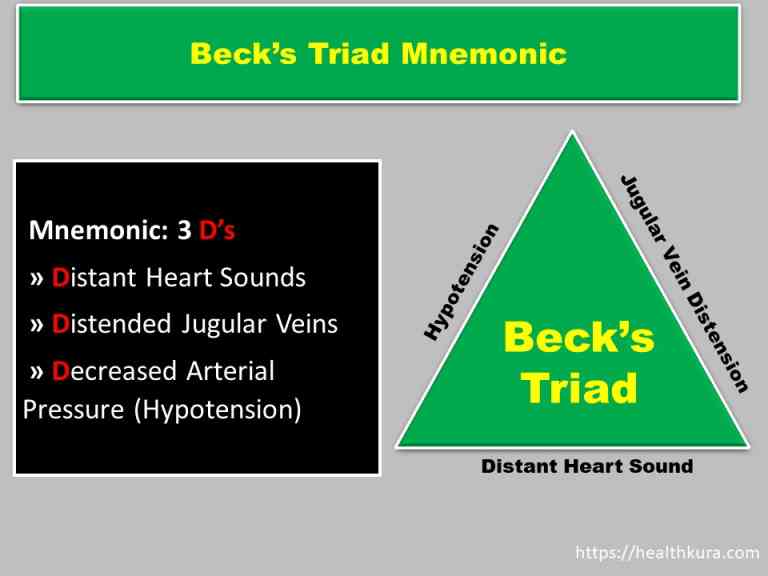
Beck’s Triad Mnemonic (Cardiac tamponade triad mnemonics)
3 D’s
» Distant Heart Sounds
» Distended Jugular Veins
» Decreased Arterial Pressure (Hypotension)
Beck’s Cognitive Triad for Depression
Some people might get confused about Beck’s Triad for Beck’s Cognitive triad of Depression. But it is a completely different condition that is associated with psychology and psychiatry. Also known as a negative triad, Beck’s cognitive triad is a cognitive-therapeutic view of the three key elements of a person’s belief system present in depression.
It was proposed by Aaron Beck in 1976. The triad forms part of his cognitive theory of depression and the concept is used as part of Cognitive Behavioral Therapy (CBT), particularly in Beck’s “Treatment of Negative Automatic Thoughts” (TNAT) approach.
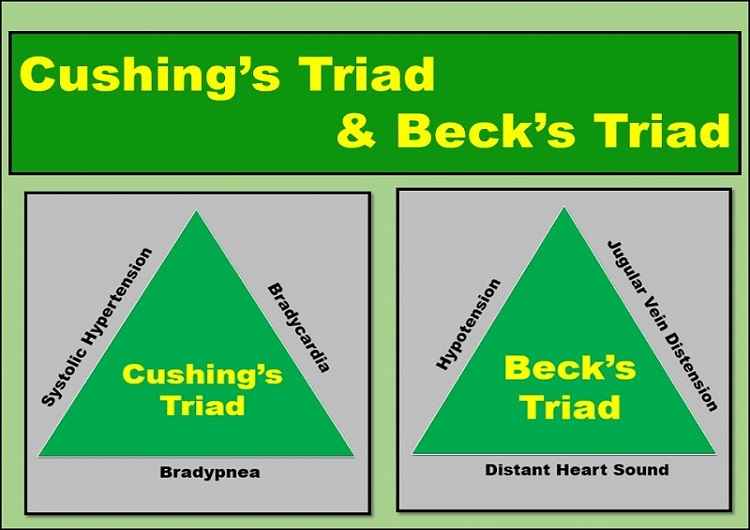
Beck’s Triad vs Cushing’s Triad
Beck’s triad is a characteristic feature of cardiac tamponade in cardiology whereas Cushing’s triad is seen in increased intracranial pressure or ICP. Similarly, Distant Heart Sounds, Distended Jugular Veins, and Decreased Arterial Pressure (Hypotension) (3Ds) are hallmarks of becks triad. But, bradypnea, systolic hypertension, and bradycardia are the characteristic features of the Cushings triad.
YOU MAY ALSO LIKE: Hot Potato Voice or Speech in Peritonsillar Abscess
Treatment of Cardiac Tamponade with Beck’s Triad
As it is a medical emergency, a patient with a cardiac tamponade triad needs immediate hospitalization. There is no intervention you can do pre-hospital for the patient. The doctor will treat the patient to relieve pressure on your heart and then treat the underlying condition. Initial treatment involves your doctor making sure you’re stabilized.
Your doctor will use a needle to drain the fluid from your pericardial sac. This procedure is called pericardiocentesis. Your doctor may perform a more invasive procedure called a thoracotomy to drain blood or remove blood clots if you have a penetrating wound. There might be a condition to remove part of your pericardium to help relieve pressure on your heart.
Let’s summarize Beck’s triad in cardiac tamponade with the following question:
Question 1
Which of the given options best describes Beck’s Triad?
Answer Choices
- Hypertension, JVD, muffled heart sounds
- Hypotension, JVD, muffled heart sounds
- Hypertension, bradycardia, irregular breathing
- Fever, Pain, Jaundice
Explanation
The Correct Answer is B – Hypotension, JVD, and muffled heart sounds.
Answer A – is incorrect. Cardiac Tamponade Triad includes hypotension, not hypertension.
Answer C – is incorrect. It describes Cushing’s Triad in pt. with increased intracranial pressure in cases such as traumatic intracranial hemorrhage from trauma.
Answer D – is incorrect. It describes Charcot’s Triad in pt. with ascending cholangitis
Sources
- Ogilvy, CS; Dubois AB (1987). “Effect of increased intracranial pressure on blood pressure, heart rate, respiration and catecholamine levels in neonatal and adult rabbits”. Biology of the Neonate. 52 (6): 327–336. doi:10.1159/000242728. PMID 3435736.
- Ayling, J (2002). “Managing head injuries”. Emergency Medical Services. 31 (8): 42. PMID 12224233.
- Cushing, H (1901). “Concerning a definite regulatory mechanism of the vasomotor centre which controls blood pressure during cerebral compression”. Bull Johns Hopkins Hosp. 12: 290–2.
- Caroline, Nancy (2013). Emergency Care in the Streets (7th ed.). Jones and Bartlett Learning. p. 1665. ISBN 978-1-4496-4151-1.
- Early management of severe traumatic brain injury. Rosenfeld JV, Maas AI, Bragge P, Morganti-Kossmann MC, Manley GT, Gruen RL Lancet. 2012 Sep 22; 380(9847):1088-98. [PubMed]
- https://codehealth.co/case/376
- Harper RJ. Pericardiocentesis. In Clinical Procedures in Emergency Medicine, 5th ed. Roberts JR, Hedges JR, et al. eds. Saunders, Philadelphia, 2010.
- https://medlineplus.gov/ency/article/000194.htm
- https://www.roshreview.com/blog/teaching-image-cardiac-tamponade/
- Chaiwat O, Sharma D, Udomphorn Y, Armstead WM, Vavilala MS J Neurotrauma. 2009 May; 26(5):657-63. [PubMed]
YOU MAY ALSO LIKE
Rings in Eyes (Ophthalmology): Cholesterol, Blue, & More
Carpal Bones Mnemonic: Wrist Bones Names in Order
Cushing’s Triad in ICP: Pathophysiology, Mnemonic, & More
Acronym for Cranial Nerves Mnemonic – Dirty, Funny Tricks
Essential Amino Acids Mnemonic: How to Memorize Fast
Spermatic Cord Contents Mnemonic – Dirty and Funny
FAQs
1. What are the three signs of Beck's Triad?
The three signs are hypotension (low blood pressure), muffled heart sounds, and distended neck veins (jugular venous distension). Low blood pressure happens because the squeezed heart cannot pump enough blood. Muffled heart sounds happen because the fluid around the heart blocks the sound of the heartbeat. Distended neck veins happen because blood backs up trying to get into the heart. These three signs together strongly suggest cardiac tamponade.
2. What is the mnemonic for Beck's Triad?
A simple mnemonic for Beck’s Triad is “Low, Muffled, Distended.” Low stands for low blood pressure. Muffled stands for muffled heart sounds. Distended stands for distended neck veins. Another mnemonic is “3 Ds: Drop, Dull, Distended.” Drop for blood pressure drop, Dull for dull heart sounds, Distended for distended veins. Choose the mnemonic that helps you remember this life-threatening combination of signs.
3. What causes cardiac tamponade?
Cardiac tamponade happens when fluid builds up in the pericardial sac, the space around your heart. Causes include trauma, like a stab wound or car accident; cancer that spreads to the pericardium; kidney failure with fluid overload; infections like tuberculosis or viral pericarditis; heart surgery; and radiation therapy to the chest. The fluid can be blood, pus, or clear fluid. Any fluid that builds up quickly can cause tamponade. Slow buildups are less dangerous because the sac can stretch over time.